
Introduction
Healthcare applications handle highly sensitive information, including medical histories, prescriptions, diagnostic reports, insurance details, and treatment records. As healthcare providers expand their digital services, protecting this information becomes an essential part of application development. A security weakness can expose patient data, disrupt healthcare operations, and create legal and reputational risks.
In the United States, the Health Insurance Portability and Accountability Act (HIPAA) establishes requirements for protecting certain health information handled by covered entities and their business associates. Developing a HIPAA-compliant healthcare application therefore requires more than adding a login screen or encrypting a database. It involves understanding how patient information is collected, accessed, stored, transmitted, and managed throughout its lifecycle.
This guide explains the essential considerations for HIPAA-compliant app development, including security architecture, privacy requirements, application features, third-party integrations, testing, and ongoing compliance responsibilities.
What Is HIPAA-Compliant App Development?
HIPAA-compliant app development involves designing, building, testing, and maintaining healthcare software in a way that supports applicable HIPAA Privacy, Security, and Breach Notification Rule requirements. The specific obligations depend on the organization, the information involved, and the relationship between the parties handling it.
Protected health information (PHI) generally refers to individually identifiable health information maintained or transmitted by a HIPAA-covered entity or its business associate, subject to the law’s definitions and exceptions. When this information is handled electronically, it is commonly called electronic protected health information (ePHI).
A healthcare application may handle ePHI when it allows patients to access medical records, enables clinicians to review treatment histories, supports telehealth consultations, or connects healthcare organizations with laboratories and insurance systems. Organizations must assess whether HIPAA applies to their activities and determine their respective responsibilities.
HIPAA compliance is not a certification automatically granted to an application because it includes specific security features. Organizations must evaluate their legal obligations, implement appropriate safeguards, maintain required policies and documentation, and continually assess their compliance.
Why HIPAA Matters in Healthcare App Development
Healthcare applications connect patients, providers, administrators, and external systems. Each connection introduces potential points where sensitive information could be accessed, modified, or disclosed improperly. Strong privacy and security practices help organizations manage these risks while supporting reliable digital healthcare services.
HIPAA considerations also influence application functionality. A patient portal must distinguish between the information a patient can access and the information available to clinical staff. A telehealth platform must consider how consultations and associated records are protected. A healthcare analytics application must evaluate how patient information is used and whether the intended processing and disclosure are permitted.
Addressing these requirements early helps development teams incorporate privacy and security into the architecture rather than attempting to retrofit them after the application has been built.
Essential Features of a HIPAA-Compliant Healthcare App
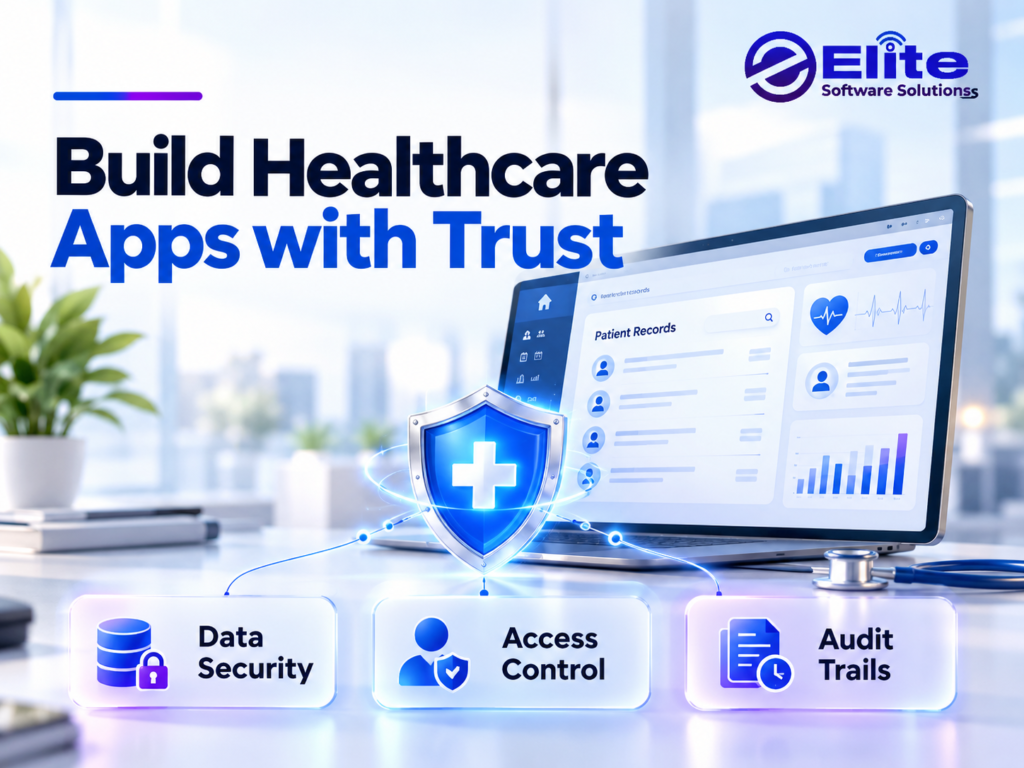
Authentication and Role-Based Access Control
Healthcare applications should verify user identities and restrict access according to legitimate responsibilities and permissions. A clinician may need access to treatment records, while an administrative employee may require access only to scheduling or billing information.
Role-based access control, appropriate authentication mechanisms, and multifactor authentication where suitable can help reduce unauthorized access. Organizations should also establish procedures for reviewing permissions and removing access when employees change roles or leave.
Encryption and Secure Data Transmission
Sensitive health information should be protected while transmitted between devices, application servers, databases, and integrated systems. Appropriate encryption and secure communication protocols can reduce the risk of interception and unauthorized disclosure.
Stored information also requires careful protection, including suitable encryption, key management, access restrictions, and secure backup practices. Encryption alone does not establish HIPAA compliance; it must form part of a broader security and risk-management approach.
Audit Logs and Activity Monitoring
Healthcare organizations need appropriate mechanisms to record and review activities involving systems that contain or use ePHI. Audit logs can help establish who accessed a record, when an action occurred, and whether information was changed or exported.
Logging should capture relevant security events without unnecessarily duplicating sensitive patient information into unsecured files. Organizations should protect logs from unauthorized modification and establish procedures for reviewing suspicious activity.
Data Integrity and Secure Record Management
Healthcare records must remain accurate and protected against unauthorized alteration or destruction. Applications should validate changes, maintain appropriate audit trails, and implement reliable backup and recovery procedures.
When clinical records are updated, the system should preserve sufficient information to understand the change and determine who made it. Recovery procedures should also be tested so that technical failures do not leave critical information unavailable when healthcare teams need it.
Session Management and Device Security
Healthcare professionals may access applications from clinical workstations, laptops, tablets, and mobile devices. Appropriate session timeouts, secure authentication, device management, and protection against unauthorized local storage can reduce risks associated with lost devices and unattended sessions.
Mobile applications should minimize sensitive information stored locally and handle cached data, notifications, downloaded files, and session credentials securely.
Privacy and Information Disclosure Controls
Healthcare applications should support the organization’s applicable privacy policies and procedures for handling patient information. Depending on the application, this may include consent workflows, patient communication preferences, access requests, and restrictions on specific uses or disclosures.
Consent alone does not make every use of health information permissible. Organizations must evaluate the applicable HIPAA requirements and other relevant laws, contractual obligations, and clinical policies.
Understanding HIPAA’s Core Rules
HIPAA Privacy Rule
The Privacy Rule governs the use and disclosure of PHI and establishes protections and rights relating to that information. Development teams should understand how the application supports permitted uses, appropriate access, and the organization’s privacy processes.
For example, a patient-facing application should not expose another patient’s records because of an incorrect account association or a predictable record identifier. Access restrictions should be enforced by server-side authorization logic, not merely by hiding interface elements.
HIPAA Security Rule
The Security Rule addresses safeguards for electronic protected health information. It includes administrative, physical, and technical safeguards intended to protect the confidentiality, integrity, and availability of ePHI.
For development teams, this means security must extend beyond the visible app interface. It includes identity management, server configuration, access permissions, audit logging, data protection, risk management, incident response, and the security of supporting systems.
HIPAA Breach Notification Rule
The Breach Notification Rule establishes notification requirements following certain breaches of unsecured PHI. Covered entities and business associates have responsibilities that depend on their roles and the circumstances of the incident.
Healthcare applications should therefore be supported by an incident response process that can identify potential breaches, preserve evidence, investigate what happened, and notify the responsible organization promptly. Notification decisions should follow applicable legal requirements rather than relying solely on automated technical alerts.
The Role of a Healthcare Software Development Company
Choosing an experienced technology partner can help healthcare organizations translate regulatory and operational requirements into practical software design decisions. A healthcare software development company should understand secure architecture, healthcare workflows, system interoperability, and testing throughout the software lifecycle.
The development team should work with the healthcare organization’s privacy, security, compliance, and operational stakeholders to clarify requirements before implementation begins. This includes identifying the types of information the application will handle, the systems it will connect to, the users who need access, and the responsibilities of external vendors.
The team should document design decisions, test security controls, support appropriate auditability, and plan for ongoing maintenance. Technical implementation is an important part of the process, but the healthcare organization remains responsible for determining and meeting its own applicable compliance obligations.
The HIPAA-Compliant App Development Process
Requirements Analysis and Risk Assessment
Begin by defining the app’s purpose, intended users, workflows, data flows, and integrations. Identify where PHI enters the system, where it is stored, who can access it, and which external services process it.
The organization should conduct the required risk analysis and establish a risk management plan appropriate to its environment. These findings inform architecture decisions, access controls, vendor selection, testing, and operational procedures.
Secure Architecture and Technology Selection
Design the application around least-privilege access, secure communication, appropriate monitoring, and reliable recovery. Select frameworks, hosting services, databases, and third-party components based on technical suitability and their ability to support the organization’s security and compliance requirements.
If cloud services create, receive, maintain, or transmit ePHI on behalf of a covered entity or business associate, the parties must evaluate applicable business associate obligations. Using a cloud platform does not automatically transfer the healthcare organization’s compliance responsibilities to the provider.
Development and System Integration
Develop the application using secure coding practices and enforce authorization rules on the server side. Validate inputs, protect API endpoints, manage secrets securely, and ensure that sensitive information is not unnecessarily exposed through error messages, analytics tools, or application logs.
Integrations with electronic health record systems, laboratories, payment providers, and other services require particular attention. Each integration should use suitable authentication, limited permissions, secure data transfer, and clearly defined responsibilities.
Testing and Security Validation
Before launch, evaluate the app’s functionality, authorization logic, data handling, API security, session management, error handling, and recovery mechanisms. Security testing may include code reviews, vulnerability scanning, penetration testing, and checks against realistic misuse scenarios.
Testing should confirm that users cannot access records beyond their permissions, that relevant security events are logged appropriately, and that sensitive information is not exposed through backups, exports, notifications, or debugging tools.
Deployment and Ongoing Maintenance
Deployment is not the end of the compliance process. Organizations need procedures for vulnerability management, security updates, access reviews, incident response, backups, monitoring, and changes to application functionality.
New integrations and features can introduce new risks, so significant changes should be reviewed before release. Organizations should maintain relevant documentation and periodically reassess safeguards as their technology and operational environment evolve.
Business Associate Agreements and Third-Party Vendors
Healthcare applications often rely on cloud hosting, messaging services, analytics tools, customer support platforms, and external software providers. These services should be assessed based on the information they handle and the role they perform.
When a vendor qualifies as a business associate, applicable HIPAA rules generally require a business associate agreement (BAA) and appropriate safeguards. The agreement establishes permitted uses and disclosures of PHI and other responsibilities. A vendor’s marketing claim that its service is secure does not replace this assessment.
Organizations should maintain an inventory of relevant vendors, understand where information is processed, review access permissions, and evaluate subcontractor arrangements when applicable. They should also ensure that third-party tools do not receive PHI unnecessarily.
Common Challenges in HIPAA-Compliant App Development
One common challenge is treating compliance as a checklist of technical features. Encryption, authentication, and audit logging are important, but they must operate within a broader framework of risk analysis, policies, access management, training, and incident response.
Legacy systems create another challenge. Older healthcare platforms may use inconsistent data formats, outdated interfaces, or permissions that are difficult to manage. Integration planning should account for these limitations while avoiding unnecessary exposure of sensitive information.
Third-party dependencies can also complicate compliance. An application may be well secured internally but still introduce risks through an analytics service, an unsecured integration, or a vendor that receives information without an appropriate review.
Finally, compliance requirements must be considered as an ongoing responsibility. Regular reviews, documented ownership, security updates, and continuous testing help organizations maintain appropriate protections as their workflows and technologies change.
Measuring the Success of a HIPAA-Compliant App
Success should be measured through both security performance and business usability. Relevant indicators may include unresolved vulnerabilities, access-control failures, time required to investigate security incidents, recovery performance, system availability, and completion of required reviews.
Healthcare organizations should also evaluate whether the app supports its intended workflow without encouraging users to bypass security controls. The goal is to protect sensitive information while enabling authorized users to perform their responsibilities efficiently.
Metrics should be interpreted in context. A low number of reported incidents does not by itself prove that an application is secure, just as completing a penetration test does not establish overall HIPAA compliance. A meaningful assessment combines technical evidence, documented processes, and ongoing risk management.
Conclusion
HIPAA-compliant app development requires a coordinated approach to privacy, security, software engineering, vendor management, and operational governance. Healthcare organizations should define their obligations early, map sensitive data flows, implement appropriate safeguards, test the application thoroughly, and maintain protections throughout its lifecycle.
A successful healthcare application must do more than function correctly. It must help authorized users access the right information, protect patient data from improper use or disclosure, and support the organization’s broader compliance responsibilities. Combining sound engineering practices with risk-based governance helps healthcare organizations build applications that take patient privacy seriously.
Frequently Asked Questions
What makes a healthcare app HIPAA compliant?
An app must be developed and operated within a framework that meets the applicable HIPAA requirements for the organization and the information it handles. This includes appropriate safeguards, access controls, risk management, documentation, and operational procedures. Compliance cannot be established by a single feature or vendor claim.
Does every healthcare app need to comply with HIPAA?
No. HIPAA generally applies to covered entities and their business associates, subject to the law’s definitions and exceptions. Whether a particular app or developer is subject to HIPAA depends on its relationship with regulated organizations and how it handles PHI. Other privacy laws may still apply to apps outside HIPAA.
Is encryption enough to make an app HIPAA compliant?
No. Encryption is an important security measure, but organizations must also evaluate access controls, audit controls, authentication, integrity protections, risk management, policies, and other applicable requirements.
Does a healthcare app developer need to sign a BAA?
A BAA is generally required when the developer qualifies as a business associate by performing covered functions or services involving PHI on behalf of a covered entity or another business associate. The specific relationship and activities must be assessed.
How long does HIPAA-compliant app development take?
The timeline depends on the app’s complexity, integrations, security requirements, data migration, testing needs, and organizational review processes. Compliance planning should be included from the beginning.
Can an existing healthcare app be updated to support HIPAA compliance?
Yes. An existing app can be assessed and improved through stronger access controls, better audit logging, vulnerability remediation, vendor reviews, updated documentation, and improved operational processes. The changes required depend on the assessment findings.