
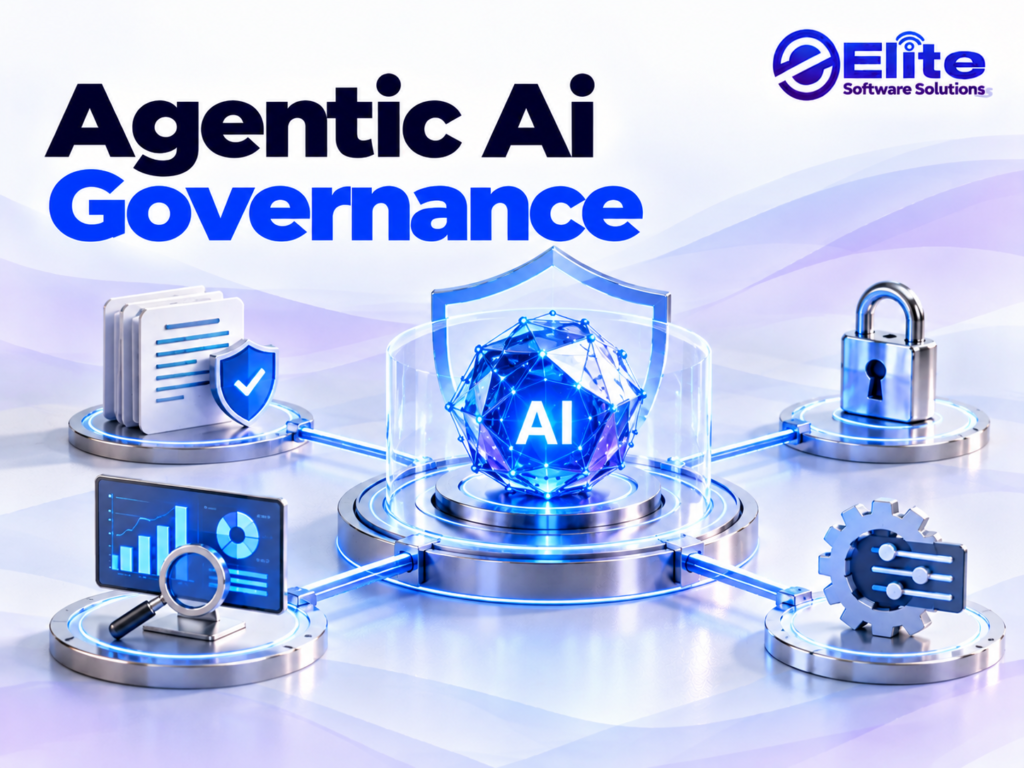
Agentic AI is changing how organizations automate business processes, coordinate complex workflows, and make operational decisions. Unlike traditional AI applications that primarily generate content or answer questions, autonomous AI agents can plan tasks, interact with software tools, retrieve information, and execute multi-step activities with varying levels of independence.
These capabilities create new opportunities for productivity, but they also introduce questions about accountability, access, oversight, and risk. What happens when an AI agent makes an incorrect decision, accesses information beyond its intended scope, or takes an action that conflicts with business policy? Who is responsible for reviewing its behavior, and how can an organization demonstrate that the system operates within acceptable boundaries?
Agentic AI governance provides a structured approach to answering these questions. It establishes the policies, responsibilities, technical controls, and monitoring processes needed to ensure that autonomous AI systems remain aligned with organizational objectives and risk tolerance.
In 2026, businesses need governance that extends beyond model selection and initial testing. They must manage the entire agent lifecycle, including design, deployment, permissions, runtime behavior, incident response, and retirement. This guide explains the core principles of agentic AI governance and presents a practical framework organizations can adapt to manage autonomous AI systems responsibly.
What Is Agentic AI Governance?
Agentic AI governance is the framework of policies, processes, accountability structures, and technical safeguards used to direct and supervise AI agents throughout their lifecycle.
Traditional AI governance often focuses on model performance, data quality, fairness, privacy, transparency, and compliance. These remain important for agentic systems, but autonomous agents introduce additional considerations because they may interact with external tools, make sequential decisions, delegate tasks, and change business records or trigger operational processes.
For example, a conventional AI assistant might recommend how a company should handle a customer refund. An AI agent integrated with a customer service platform could retrieve the relevant order, evaluate the request, update a record, and initiate a refund workflow. Governance must therefore address not only whether the recommendation is appropriate, but also whether the agent is authorized to act, whether its decisions follow company policy, and whether its actions can be audited or reversed.
Effective governance connects business objectives with enforceable technical controls. It defines what an agent is allowed to do, which information it can access, when human approval is necessary, how its performance is evaluated, and who is accountable for its operation.
The objective is not to prevent autonomy altogether. It is to make autonomy purposeful, proportionate to risk, and subject to meaningful oversight.
Why Agentic AI Governance Matters in 2026
As businesses move AI agents from experimentation into operational workflows, governance becomes essential for controlling how these systems interact with people, data, and enterprise applications.
Autonomous Actions Increase Business Risk
An AI agent can do more than produce an inaccurate answer. Depending on its permissions, it may update customer records, send external communications, modify software configurations, or initiate financial transactions. Governance must establish which actions are appropriate for independent execution and which require additional authorization.
Multiple Integrations Complicate Accountability
Enterprise agents often connect to databases, email systems, document repositories, customer relationship management platforms, and third-party APIs. Each integration introduces questions about access permissions, data handling, operational responsibility, and auditability.
Without clear governance, organizations may struggle to determine whether an agent’s action was authorized or which system owner should investigate a problem.
Errors Can Propagate Across Workflows
An agent may use the output of another agent or rely on information retrieved from an external source. If an early step produces incorrect information, subsequent agents may use it to make additional decisions. Governance must therefore address the complete workflow rather than evaluating each agent in isolation.
Regulatory and Organizational Expectations Are Evolving
Organizations must consider applicable privacy, cybersecurity, consumer protection, industry-specific, and AI-related obligations when deploying autonomous systems. Requirements vary by jurisdiction and use case, so governance should include a process for identifying which obligations apply rather than assuming that one policy fits every deployment.
Trust Requires Evidence and Accountability
Business leaders, employees, customers, and regulators need appropriate assurance that AI agents operate within approved boundaries. Documented ownership, traceable actions, repeatable testing, and effective incident response provide a stronger foundation for trust than relying on vendor assurances alone.
Core Principles of Effective Agentic AI Governance
A governance framework should establish consistent expectations for how agents are designed, deployed, supervised, and improved. These principles provide the foundation for making governance practical across different business functions.
Accountability and Clear Ownership
Every production agent should have an identifiable business owner and a technical owner. The business owner is responsible for ensuring that the agent serves an approved purpose and operates within the organization’s risk tolerance. The technical owner manages its implementation, integrations, permissions, monitoring, and maintenance.
Security, privacy, legal, and compliance teams should contribute according to the agent’s intended use and potential impact. Clear ownership ensures that decisions about deployment, exceptions, incidents, and retirement do not fall into an accountability gap.
Risk-Proportionate Autonomy
Not every agent requires the same level of supervision. An agent that summarizes public information presents a different risk profile from one that changes financial records or accesses sensitive customer data.
Governance should therefore determine the permitted level of autonomy based on potential harm, data sensitivity, reversibility, and business criticality. Lower-risk activities may operate with routine monitoring, while high-impact actions should require stronger authorization, additional validation, and human review.
Transparency and Traceability
Organizations need sufficient visibility into what an agent is designed to do, which tools it can access, what decisions it makes, and what actions it performs. This does not necessarily require exposing every internal model computation. It requires maintaining useful evidence that enables people to understand and investigate consequential behavior.
Traceability should connect an initiating request with the agent identity, relevant inputs, tool calls, policy checks, approvals, and resulting changes. Records must also be protected against unauthorized modification and excessive access.
Security and Privacy by Design
Security should be incorporated during architecture and development rather than added after deployment. Agent identities, permissions, data boundaries, tool access, and runtime controls should be designed around the intended use case.
Privacy considerations should include data minimization, retention, access restrictions, and the handling of confidential information by models and connected services. Governance should also account for risks introduced by third-party components and external data sources.
Continuous Evaluation and Improvement
An agent that performs well during testing may behave differently after a model update, a change in its instructions, a new tool integration, or a shift in the business environment.
Governance should require periodic evaluation of performance, policy compliance, security, and operational impact. Significant changes should trigger reassessment, and incidents should inform improvements to the agent’s controls and operating procedures.
A Practical Framework for Managing Autonomous AI Systems
Organizations can implement agentic AI governance through a lifecycle-based framework that connects policy, engineering, oversight, and continuous improvement. The following stages provide a practical starting point for enterprises developing or adopting autonomous AI systems.
Stage 1: Define the Purpose and Scope
Every agent should begin with an approved business objective and a clearly documented scope. The organization should specify the problem it is intended to solve, the users it serves, the decisions it may support, and the actions it may perform.
The scope should also define prohibited activities, operating constraints, and conditions that require escalation. For example, a customer service agent might be authorized to retrieve order details and prepare a refund recommendation while being prohibited from approving high-value refunds independently.
A well-defined scope provides the reference point for evaluating whether the agent’s behavior remains appropriate throughout its lifecycle.
Stage 2: Conduct a Risk Assessment
Before deployment, assess the potential consequences of incorrect decisions, unauthorized actions, data exposure, manipulation, and operational failure. Consider the sensitivity of accessible information, the agent’s autonomy, the number of systems it can affect, and whether its actions can be reversed.
The assessment should examine both the agent itself and the wider workflow in which it operates. An agent with limited individual permissions may still contribute to a high-impact process when combined with other agents or automated systems.
Risk assessments should determine the level of testing, approval, monitoring, and human oversight required before the agent can enter production.
Stage 3: Establish Identity and Access Controls
Every agent should operate through an appropriately managed identity with permissions limited to its approved responsibilities. Shared credentials, unrestricted administrator access, and unnecessary privileges can make failures more damaging and investigations more difficult.
Access should be enforced by the systems the agent interacts with, rather than relying on the model to follow instructions. Organizations should also define credential rotation, permission review, revocation, and separation between development and production environments.
Stage 4: Set Human Oversight and Approval Requirements
Governance should specify when an agent can act independently and when a person must review or authorize a decision. These requirements should reflect the potential impact of the action, not simply the technical ability of the agent to execute it.
For sensitive financial transactions, changes to critical records, external communications with significant consequences, or access to restricted information, explicit approval may be appropriate. Approval interfaces should clearly explain the proposed action, its target, its expected impact, and any material uncertainty.
An approval should apply to the specific action being authorized. If the agent changes important parameters afterward, the system should request renewed approval.
Stage 5: Test Before Production Deployment
Testing should evaluate whether the agent meets its business requirements and respects its operating boundaries. This includes testing expected tasks, unusual inputs, conflicting instructions, unauthorized tool calls, access restrictions, sensitive data handling, and failure scenarios.
Multi-agent systems require additional testing of delegation, message validation, workflow dependencies, and cascading errors. Organizations should also confirm that monitoring, approval gates, and emergency shutdown mechanisms work as intended.
Deployment should proceed only when the organization has sufficient evidence that the agent meets the acceptance criteria established for its risk level.
Stage 6: Monitor Runtime Behavior
Governance must continue after an agent enters production. Monitoring should examine whether the agent is performing its intended tasks, following policies, using authorized tools, and remaining within expected operational limits.
Organizations should establish thresholds for unusual activity, repeated failures, policy violations, unexpected data access, and changes in behavior. When a threshold is exceeded, the response might involve blocking an action, requesting human review, restricting permissions, or suspending the agent.
Monitoring records should be useful for investigations while protecting sensitive information and credentials.
Stage 7: Manage Changes and Incidents
Model changes, new integrations, revised instructions, expanded permissions, and modifications to business workflows can materially affect an agent’s risk profile. Governance should define which changes require review, regression testing, or formal reapproval before deployment.
Organizations also need incident procedures covering containment, investigation, communication, recovery, and remediation. They should be able to disable an agent, revoke its credentials, stop dependent workflows, and identify actions already completed.
After an incident, the organization should determine whether the failure arose from unclear requirements, excessive permissions, inadequate testing, poor monitoring, or another weakness, and update the framework accordingly.
Stage 8: Review, Reapprove, or Retire the Agent
Agents should undergo periodic reviews to determine whether they remain necessary, effective, and appropriately controlled. Reviews should consider operational performance, policy compliance, changes in business requirements, security findings, and the ongoing suitability of connected tools and data sources.
If an agent is no longer needed or cannot meet required safeguards, it should be retired through a controlled process that revokes credentials, removes integrations, handles retained data appropriately, and preserves necessary audit records.
This final stage closes the lifecycle and prevents outdated agents from remaining active without meaningful ownership or oversight.
Frameworks and Standards That Support Agentic AI Governance
Organizations do not need to create every governance principle from scratch. Existing risk management and security resources can provide a foundation, although agentic AI deployments may require additional controls for autonomy, tool access, delegation, and runtime behavior.
The NIST AI Risk Management Framework provides a general structure for incorporating trustworthiness into the design, development, use, and evaluation of AI systems. Its Govern, Map, Measure, and Manage functions can help organizations establish accountability, identify risks, evaluate controls, and manage issues throughout the AI lifecycle.
NIST
The OWASP Top 10 for Agentic Applications for 2026 provides a more agent-specific perspective. It identifies risks involving goal hijacking, tool misuse, identity and privilege abuse, supply-chain weaknesses, memory poisoning, inter-agent communication, cascading failures, and rogue agents. These risks can help organizations strengthen their threat assessments and technical governance controls.
OWASP Gen AI Security Project+1
Businesses operating in or serving the European Union should also assess the applicability of the EU AI Act and related obligations. As of October 2026, the Act’s requirements apply on a phased timeline, and obligations vary according to the system, role, and use case. Organizations should consult the European Commission’s AI Act implementation guidance and obtain qualified advice where necessary rather than assuming that every agent is subject to identical requirements.
Shaping Europe’s digital future+1
These resources serve different purposes. NIST supports broad AI risk management, OWASP helps identify agent-specific security threats, and applicable laws establish legal obligations. A mature governance program connects them to the organization’s actual workflows, risks, and responsibilities.
Key Risks That Agentic AI Governance Must Address
Excessive Permissions and Unauthorized Actions
An agent with broad access can make a minor error significantly more consequential. Governance should require least-privilege permissions, explicit action boundaries, and independent authorization checks. Access should be reviewed whenever the agent’s responsibilities change.
Prompt Injection and Manipulated Instructions
Agents may encounter malicious instructions in documents, emails, websites, and retrieved content. Governance should require appropriate input validation, trusted-source controls, policy enforcement, and safeguards that prevent untrusted content from overriding approved operating boundaries.
Data Privacy and Confidentiality
An agent may retrieve or expose information that exceeds the user’s authorization or the agent’s intended purpose. Organizations should enforce access controls at retrieval and execution time, minimize unnecessary data processing, and define retention and deletion requirements for information handled by the agent.
Cascading Failures Across Multiple Agents
When agents delegate tasks or exchange information, one incorrect output can affect several downstream processes. Governance should establish limits on delegation, validation between workflow stages, execution budgets, failure isolation, and human intervention for consequential decisions.
Unclear Accountability
If business teams, developers, vendors, and security teams have overlapping responsibilities, it may be difficult to determine who owns an agent’s actions and associated risks. Every production agent should have clearly assigned business and technical ownership, documented approval responsibilities, and defined incident escalation procedures.
Inadequate Monitoring and Auditability
Without sufficient records, organizations may be unable to reconstruct why an agent acted or whether it followed the required policies. Monitoring should capture security-relevant events, tool calls, authorization outcomes, approvals, and resulting changes while protecting sensitive information.
How to Measure the Effectiveness of Agentic AI Governance
A governance framework should produce measurable evidence that agents are operating safely and delivering their intended business value. Organizations should establish a baseline before deployment and select measures that reflect the agent’s purpose and risk level.
Policy compliance can be evaluated by examining the frequency of unauthorized action attempts, policy violations, and exceptions requiring intervention. Access governance can be assessed through periodic permission reviews, the number of excessive privileges identified, and the time required to revoke access when an agent is suspended.
Operational measures should include the frequency of failed workflows, inappropriate actions, successful recoveries, and incidents requiring human intervention. Organizations can also assess whether agents improve task completion, reduce manual effort, and meet the business objectives that justified their deployment.
For higher-risk agents, governance reviews should examine whether approval requirements are consistently enforced, audit records are complete, and incident response mechanisms work under realistic conditions. These measures should be interpreted in context: a low incident count alone does not demonstrate effective governance if monitoring is incomplete or failures are not being reported.
How Agentic AI Development Services Can Support Governance
Organizations developing autonomous AI systems need governance considerations to shape the architecture from the beginning. This includes defining agent responsibilities, establishing identity and access controls, securing tool integrations, implementing human approval workflows, and designing monitoring and recovery mechanisms.
Businesses exploring Agentic AI can benefit from a development approach that treats governance as part of the complete solution rather than a separate compliance exercise. The right implementation should connect business requirements with enforceable technical controls, documented ownership, structured testing, and ongoing evaluation.
For example, an enterprise workflow agent could be designed to retrieve authorized records, prepare a recommendation, validate the proposed action against business rules, and request approval before making a sensitive change. Its activity could then be recorded for review, with a mechanism to suspend the workflow if unexpected behavior occurs.
The goal is to create systems whose capabilities, permissions, and oversight mechanisms are aligned from the outset. Development decisions should reflect the organization’s risk tolerance, operational requirements, and applicable obligations.
Agentic AI Governance and Security: Related Reading
Governance and security are closely connected, particularly when autonomous agents can access sensitive information and execute actions through enterprise tools. A governance policy may define what an agent is allowed to do, while security controls enforce those boundaries and help detect violations.
For a deeper look at the technical threats organizations need to manage, read Agentic AI Security: Risks & Governance for Enterprises. This previously published article explores risks such as prompt injection, tool misuse, excessive permissions, memory poisoning, and cascading failures, along with practical safeguards for enterprise AI deployments.
Together, governance and security provide a more complete approach: governance establishes accountability and acceptable boundaries, while technical controls help enforce those boundaries throughout the agent’s lifecycle.
Conclusion
Agentic AI governance is essential for organizations that want to deploy autonomous systems responsibly and at scale. As agents gain the ability to access enterprise information, coordinate workflows, and execute actions, businesses need clear rules governing their authority, accountability, and ongoing supervision.
A practical framework begins with a defined purpose and risk assessment, establishes identity and access controls, specifies human approval requirements, and incorporates testing before deployment. Runtime monitoring, incident response, change management, and periodic reviews then help maintain those controls as the system evolves.
Organizations can use established resources such as the NIST AI Risk Management Framework and OWASP’s agent-specific security guidance as foundations, adapting them to their operational and regulatory context.
Ultimately, effective governance is not about preventing all autonomy. It is about ensuring that autonomous AI systems remain useful, accountable, secure, and aligned with the organization’s objectives throughout their operational life.
Frequently Asked Questions
What Is Agentic AI Governance?
Agentic AI governance is the set of policies, responsibilities, processes, and technical controls used to manage autonomous AI agents. It defines their permitted activities, access rights, oversight requirements, risk controls, and accountability throughout their lifecycle.
Why Is Agentic AI Governance Important in 2026?
As businesses integrate AI agents into operational workflows, the consequences of unauthorized actions, data exposure, and cascading failures become more significant. Governance helps organizations manage these risks while maintaining appropriate oversight and accountability.
What Are the Main Components of an Agentic AI Governance Framework?
A practical framework includes purpose definition, risk assessment, identity and access management, human oversight, security testing, runtime monitoring, incident response, change management, and periodic review. The specific controls should reflect the agent’s capabilities and potential impact.
How Does Agentic AI Governance Differ From Traditional AI Governance?
Traditional AI governance often emphasizes model quality, fairness, privacy, transparency, and responsible use. Agentic AI governance also addresses the authority to act, access to tools, delegation between agents, execution boundaries, and the consequences of autonomous decisions.
What Frameworks Can Businesses Use for Agentic AI Governance?
The NIST AI Risk Management Framework provides a broad structure for managing AI risks, while the OWASP Top 10 for Agentic Applications helps identify security risks specific to autonomous systems. Organizations should combine relevant guidance with applicable legal requirements and internal policies.
How Can Businesses Maintain Human Oversight Without Eliminating Automation?
Businesses can use risk-based approval policies. Low-impact, reversible tasks may run with routine monitoring, while sensitive or difficult-to-reverse actions require explicit approval. Clear escalation rules and the ability to suspend an agent help maintain control without requiring manual review of every operation.
Who Should Be Responsible for Agentic AI Governance?
Responsibility should be shared across business owners, technical teams, security, privacy, legal, and compliance functions as appropriate. Each production agent should have identifiable owners and clearly documented responsibilities for approval, monitoring, maintenance, and incident response.
How Often Should Agentic AI Systems Be Reviewed?
Reviews should occur at planned intervals and whenever material changes affect the agent’s model, permissions, tools, data sources, or business purpose. Security incidents and significant policy violations should also trigger reassessment.