
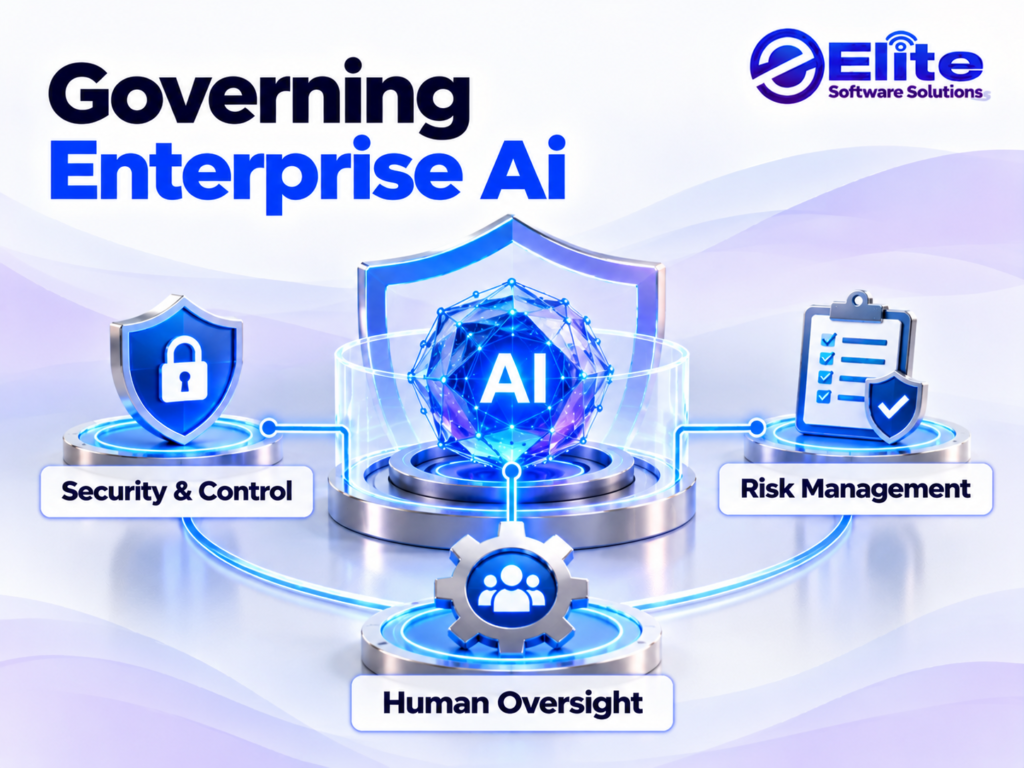
Artificial intelligence is evolving beyond answering questions, generating content, and making predictions. Businesses are increasingly exploring systems that can understand objectives, plan tasks, interact with software, and take action with limited human involvement. This shift is creating new opportunities for enterprise automation, while raising an important question: how can organizations ensure autonomous AI systems operate safely, responsibly, and in accordance with business rules?
Consider an AI agent operating within a financial services company. It receives a request, retrieves customer information, verifies account details, prepares a recommendation, and initiates the next step in a business workflow. While this process can save employees considerable time, an error could expose confidential information, affect a customer account, or trigger an unauthorized transaction.
This is where AI governance becomes essential. Enterprises cannot simply connect an AI agent to business applications and assume it will consistently make the right decisions. They need clear policies, technical safeguards, monitoring procedures, and accountability structures that establish what an agent can and cannot do.
In 2026, Agentic AI is becoming increasingly important to enterprise automation. Governance is therefore essential for organizations moving autonomous AI from experimentation into day-to-day business operations. A well-designed strategy allows businesses to benefit from automation while maintaining control over security, data, decision-making, and operational risk.
This guide examines the frameworks, challenges, and practical governance measures enterprises should consider when adopting autonomous AI systems.
What Is Agentic AI Governance?
Agentic AI governance encompasses the policies, processes, technical controls, and accountability mechanisms organizations use to manage AI agents throughout their lifecycle. It ensures that autonomous systems operate in alignment with approved business objectives, security requirements, organizational policies, and applicable regulations.
Unlike conventional AI applications, which primarily generate responses or predictions, agentic systems can carry out multiple connected tasks. They may retrieve information, interact with APIs, update business records, communicate with other agents, and take action through integrated applications.
For example, an enterprise customer service agent might receive a complaint, identify the issue, retrieve the customer’s record, review the company’s support policy, and prepare a response. Depending on its permissions, it may also update a support ticket or initiate an approved refund workflow.
Governance defines the level of autonomy an agent is allowed to exercise. It establishes which information the agent can access, which actions it can perform, which decisions require human approval, and how its activities are documented.
The objective is not to prevent AI agents from operating independently. It is to ensure their autonomy remains appropriate, controlled, and aligned with business responsibilities.
Why Agentic AI Governance Matters for Enterprises in 2026
Enterprise adoption of autonomous AI introduces a new level of operational responsibility. An AI assistant that recommends an action presents one type of risk; an agent that can execute that action within a production system presents another.
As organizations connect agents to customer platforms, financial applications, internal databases, cloud services, and operational systems, the potential consequences of an incorrect decision become more significant.
Controlling Autonomous Decision-Making
AI agents can interpret instructions and select actions based on available information. However, they may misunderstand an instruction or act on incomplete information.
For example, an agent managing procurement requests might misinterpret an unusual purchase requirement or recommend a supplier that does not meet company policy.
Governance sets clear decision boundaries, defines which activities an agent may complete independently, and establishes escalation procedures for situations that require human judgment.
Protecting Enterprise Information
AI agents often need access to business information to complete their tasks, including customer records, employee information, financial documents, internal reports, and confidential intellectual property.
Without appropriate access controls, an agent may retrieve information beyond what its assigned role requires.
Governance helps businesses enforce data permissions, identity controls, encryption, retention policies, and restrictions on information sharing.
Maintaining Business Accountability
When an AI agent takes action, the organization should be able to determine what occurred, which systems were involved, and who approved or supervised the activity.
This is especially important when an agent’s decisions affect customers, financial operations, regulated information, or critical business processes.
Clear ownership and audit records help organizations investigate incidents and demonstrate that appropriate safeguards were in place.
Supporting Responsible AI Adoption
Businesses must ensure that AI systems operate in accordance with organizational values, legal obligations, and customer expectations.
Governance provides a structured way to evaluate reliability, fairness, transparency, privacy, security, and potential business impact.
Without it, organizations may struggle to scale AI adoption because they cannot confidently demonstrate how their autonomous systems are controlled.
Key Components of an Enterprise Agentic AI Governance Framework
An effective governance framework connects organizational policies with technical safeguards. Written policies are important, but they offer limited protection if an AI agent still has unrestricted access to sensitive applications.
Clear Ownership and Accountability
Every enterprise AI agent should have a designated business owner and technical owner. The business owner defines the agent’s purpose, expected outcomes, and appropriate level of autonomy. The technical owner oversees system architecture, integrations, permissions, testing, and maintenance.
Security, legal, compliance, and risk management teams should also participate when an agent handles sensitive data or performs high-impact activities.
This shared-responsibility model prevents governance from becoming an isolated IT task and connects AI adoption with the broader business risk management process.
Defined Autonomy and Permission Boundaries
Not every AI agent requires the same level of autonomy. An internal research assistant may need permission only to search approved documents, while a financial operations agent may interact with sensitive transaction systems.
Organizations should define each agent’s permitted actions before deployment. Permissions should follow the principle of least privilege: an agent receives only the access required to fulfill its assigned responsibilities.
For instance, an agent that reviews purchase requests may retrieve order information and prepare recommendations without having permission to approve payments. Higher-risk actions can remain subject to human authorization.
Data Governance and Privacy Controls
AI agents should operate within the organization’s established data governance requirements. Businesses need to know what information an agent can access, where that information is processed, and whether it is shared with external services.
Sensitive information should be classified and protected through appropriate access restrictions, encryption, and retention policies.
Organizations should also review data permissions whenever an agent’s responsibilities change. Access that was appropriate during development may become unnecessary or excessive after deployment.
Transparency and Auditability
Enterprises need reliable records of significant agent activities. Audit trails should capture relevant details about the agent’s identity, assigned task, tool usage, data access, approvals, and completed actions.
For important decisions, organizations should also retain sufficient evidence to understand the information and policies involved.
The goal is not necessarily to expose every internal model computation. Rather, it is to provide meaningful operational visibility so security teams, auditors, and business owners can understand and investigate what happened.
Continuous Monitoring and Evaluation
Governance must continue after deployment. AI agents may behave differently as business processes change, new tools are connected, or underlying models are updated.
Continuous monitoring helps organizations identify unusual tool usage, repeated errors, unexpected access attempts, and changes in performance.
Regular reviews should determine whether an agent’s permissions, safeguards, and assigned responsibilities remain appropriate.
Important Frameworks and Standards for Agentic AI Governance
Enterprises do not need to develop every governance principle from the ground up. Established AI risk management frameworks, cybersecurity standards, and regulatory guidance offer useful foundations.
However, most existing frameworks address AI governance more broadly than agent-specific concerns. Organizations must translate their principles into practical controls for autonomous decision-making, tool access, connected workflows, and human oversight.
NIST AI Risk Management Framework
The NIST AI Risk Management Framework offers guidance for identifying, assessing, and managing risks associated with AI systems.
Its four core functions are Govern, Map, Measure, and Manage.
Govern establishes organizational responsibilities, policies, and risk management practices. Map helps organizations understand an AI system’s context and potential impact. Measure focuses on evaluating risks and system characteristics, while Manage supports prioritizing and addressing identified risks.
For Agentic AI, enterprises can use this framework to assess an agent’s purpose, understand the potential consequences of its actions, evaluate its reliability, and establish appropriate safeguards.
The framework is particularly useful because it encourages organizations to treat AI risk management as an ongoing process rather than a one-time approval.
ISO/IEC 42001
ISO/IEC 42001 sets out requirements for establishing, implementing, maintaining, and continually improving an AI management system.
It helps organizations establish clear responsibilities, policies, risk assessments, operational controls, and improvement processes for AI-related activities.
For enterprises deploying autonomous agents, ISO/IEC 42001 can provide a foundation for integrating AI governance into existing management practices. Organizations can use its management-system approach to establish oversight across AI development, deployment, and operational use.
NIST Cybersecurity Framework
The NIST Cybersecurity Framework offers a structured approach to managing cybersecurity risk through six functions: Govern, Identify, Protect, Detect, Respond, and Recover.
These functions are relevant to Agentic AI because agents may interact with enterprise networks, applications, credentials, and sensitive data.
Organizations can apply cybersecurity controls to agent identities, tool integrations, access permissions, monitoring, incident response, and recovery procedures.
EU Artificial Intelligence Act
The EU Artificial Intelligence Act establishes a risk-based regulatory framework for AI systems.
Its requirements depend on a system’s classification, intended purpose, and the provisions that apply. Enterprises operating in or serving European markets should assess whether their AI systems fall within its scope and determine which obligations may apply.
The use of an AI agent does not automatically make a system high-risk. Classification depends on its intended purpose and regulatory context. Businesses should seek appropriate legal and compliance guidance rather than assume that all agent-based applications face the same requirements.
Major Risks of Agentic AI in Enterprise Environments
Agentic AI introduces risks that go beyond inaccurate responses. Because agents can interact with tools, access sensitive information, and carry out multi-step operations, organizations must pay close attention to security, permissions, and governance. For a deeper look at these challenges, read our previous article, Agentic AI Security: Risks & Governance for Enterprises, which examines the security vulnerabilities and governance considerations businesses should address when adopting autonomous AI systems.
Unauthorized Actions and Excessive Permissions
An AI agent with broad system access may take actions beyond its intended responsibilities. This can result from an incorrect instruction, a misunderstood objective, a software defect, or a compromised workflow.
For example, an agent designed to update customer records should not automatically have permission to delete entire databases or modify financial configurations.
Organizations should enforce role-based permissions, tightly scoped credentials, action limits, and approval requirements for sensitive operations.
Prompt Injection and Malicious Instructions
AI agents may process untrusted content from emails, websites, documents, customer messages, and external systems. Attackers may embed malicious instructions in this content to manipulate an agent’s behavior.
This becomes particularly concerning when an agent can use tools or retrieve confidential information. A malicious document might attempt to persuade the agent to disclose internal data or perform an unauthorized action.
Security controls should treat retrieved content as untrusted input, distinguish trusted instructions from external information, validate tool requests, and restrict access to sensitive operations.
Data Leakage and Privacy Violations
Agents may expose sensitive information by retrieving inappropriate records, sending data to unauthorized services, or including confidential details in their responses.
The risk increases when agents operate across multiple applications with different data permissions.
Enterprises should apply data classification, encryption, access restrictions, output validation, and monitoring to reduce the possibility of unauthorized disclosure.
Hallucinations and Incorrect Decisions
AI agents can produce inaccurate information or make unsuitable decisions, even when their responses appear convincing.
In an enterprise workflow, this could result in inaccurate customer updates, incorrect financial recommendations, flawed technical changes, or inappropriate business decisions.
Organizations should verify important outputs against reliable sources and require human review when an error could create significant consequences.
Uncontrolled Multi-Agent Interactions
Some enterprise architectures use multiple agents to work toward a shared objective. One agent may gather information, another may analyze it, and a third may take action.
Although this approach can improve workflow coordination, it also adds complexity. Errors or misleading information may pass between agents, and unclear responsibilities can make it difficult to determine where a failure originated.
Each agent should have a defined role, restricted permissions, clear communication boundaries, and appropriate monitoring.
Operational and Financial Impact
An agent that repeatedly takes incorrect actions can increase costs, disrupt services, and damage customer relationships.
For example, an incorrectly configured agent might generate duplicate service requests, repeatedly modify records, or initiate unnecessary transactions.
Organizations should establish spending limits, rate limits, transaction thresholds, rollback procedures, and emergency shutdown mechanisms for workflows with operational or financial consequences.
Best Practices for Implementing Agentic AI Governance
Building an effective governance strategy involves more than selecting a framework. Enterprises must translate governance principles into everyday development and operational practices.
Start With Clearly Defined Use Cases
Before developing an AI agent, businesses should identify the specific problem it is intended to solve. Its objective should be measurable, and its responsibilities should be clearly documented.
A narrowly defined use case makes it easier to assess risks, establish permissions, and evaluate whether the agent delivers meaningful business value.
Organizations should avoid granting broad autonomy simply because a platform supports it. The agent’s capabilities should match the actual requirements of the workflow.
Introduce Human Oversight Based on Risk
Human oversight should reflect the potential impact of an agent’s decisions. Low-risk tasks, such as organizing internal documents, may need limited intervention. Activities involving payments, regulated information, legal decisions, or critical infrastructure require more rigorous controls.
A practical governance policy should define which actions an agent can perform independently, which require approval, and which are prohibited altogether.
This creates a balance between automation and accountability without requiring employees to review every minor action.
Apply Least-Privilege Access
Every agent should have a distinct identity and access permissions rather than rely on unrestricted shared credentials.
Access should be limited to the applications, records, and tools necessary for its assigned tasks. Sensitive permissions should be granted only when needed, and organizations should review them regularly.
This approach helps reduce the potential damage if an agent behaves unexpectedly or its credentials are compromised.
Establish Testing Before Deployment
Agentic AI systems should undergo realistic testing before they are introduced into production environments.
Testing should examine how an agent responds to ambiguous instructions, conflicting information, malicious content, unavailable tools, unexpected system responses, and incomplete data.
Businesses should also verify whether approval requirements work correctly and whether the agent respects restrictions when a requested action falls outside its permissions.
Maintain Detailed Audit Trails
Organizations should maintain records of important agent activities, including tool calls, access requests, approvals, decisions, and completed actions.
These records help security teams investigate incidents, compliance teams review operational behavior, and developers identify weaknesses.
Audit information should be protected against unauthorized modification and retained according to the organization’s security and regulatory requirements.
Monitor Performance and Risk Continuously
An agent that performs well during initial testing may encounter new risks after deployment. Changes in business processes, data sources, model versions, and connected applications can affect its behavior.
Enterprises should monitor error rates, unauthorized tool requests, unexpected actions, task completion quality, and operational impact.
Regular reviews should determine whether the agent’s permissions, safeguards, and intended purpose remain appropriate.
Prepare Incident Response and Recovery Procedures
Organizations should establish a response plan for situations in which an AI agent takes an unauthorized action, exposes sensitive information, or disrupts a service.
The response plan should identify who can suspend the agent, revoke its credentials, disable integrations, preserve evidence, and restore affected systems.
Recovery procedures should be tested before they are needed. A well-governed agent should always have a controlled way to stop its activity when something goes wrong.
How to Build an Enterprise Agentic AI Governance Strategy
An enterprise governance strategy should align business objectives, risk management, technology architecture, and operational responsibilities.
The first stage is to assess the organization’s current AI environment. Businesses should identify existing AI applications, experimental agents, connected tools, data sources, and teams responsible for their operation. This helps reveal where autonomous capabilities already exist and where governance gaps may be developing.
The next stage is to classify AI agents according to their purpose, access level, autonomy, and potential impact. An agent that summarizes internal reports has different requirements from one that can approve transactions or modify production systems. Risk classification helps organizations apply controls proportionate to the consequences of failure.
Once risks are understood, the organization can define its governance policies. These should cover ownership, permitted use cases, access management, data handling, human approval, testing, monitoring, and incident response. Policies must be translated into technical controls so that agents cannot simply ignore organizational restrictions.
The strategy should then be tested through controlled deployments. Starting with a limited use case allows teams to evaluate actual performance, identify unexpected behavior, and improve controls before expanding adoption.
Finally, governance should become part of the organization’s ongoing operating model. AI agents need regular reviews, updated permissions, security testing, and clear ownership as their responsibilities evolve.
Measuring the Success of Agentic AI Governance
Governance effectiveness should be assessed using measurable indicators, not simply the existence of policy documentation or the number of agents deployed.
Organizations can assess how often agents complete approved tasks successfully, how frequently they require human intervention, and whether they remain within their defined permissions. Security teams can monitor unauthorized tool requests, policy violations, data access anomalies, and incidents involving autonomous actions.
Operational indicators are also important. Businesses should examine whether agents reduce processing time, improve workflow consistency, and deliver measurable value without increasing error rates or creating additional operational risks.
These measurements should be reviewed together. A high task completion rate is not a sign of success if the agent regularly bypasses approval requirements or accesses information unnecessarily.
The objective is to demonstrate that AI agents deliver business value while remaining secure, controlled, and accountable.
The Future of Agentic AI Governance in Enterprise Technology
As AI agents become more capable, enterprise governance must evolve with them. Businesses are likely to manage increasingly complex environments in which multiple agents interact with shared applications, data platforms, and operational workflows.
This will make agent identity management, permission controls, monitoring, and coordination particularly important. Organizations will need reliable ways to understand which agent performed an action, which permissions it used, and whether the action followed approved policies.
AI governance is also likely to become more closely connected with cybersecurity and software development practices. Security testing, access reviews, policy enforcement, and audit logging will need to be considered during system design rather than added after deployment.
Another important development will be the use of governance controls that operate continuously. Instead of reviewing an agent only before launch, organizations will increasingly need to evaluate its behavior as it interacts with changing business environments.
Enterprises that approach governance as an ongoing operational responsibility will be better positioned to expand Agentic AI without losing control over important business decisions.
Conclusion
Agentic AI gives enterprises new opportunities to automate complex workflows, coordinate business operations, and improve productivity. However, greater autonomy also introduces risks related to security, data privacy, inaccurate decisions, accountability, and operational disruption.
An effective governance framework helps organizations manage these challenges through clear ownership, controlled permissions, human oversight, continuous monitoring, and dependable incident response procedures. Established approaches such as the NIST AI Risk Management Framework, ISO/IEC 42001, and the NIST Cybersecurity Framework offer useful foundations when adapted to the needs of agent-based systems.
In 2026, successful enterprise AI adoption will depend on more than building capable agents. Businesses must ensure that agents operate within clearly defined boundaries and remain accountable throughout their lifecycle. By making governance an integral part of AI architecture and operations, enterprises can advance automation while maintaining the trust, security, and control their businesses require.
Frequently Asked Questions
1. What is Agentic AI governance?
Agentic AI governance is the combination of policies, processes, technical safeguards, and accountability structures used to manage autonomous AI agents. It ensures that agents operate within approved business objectives, access permissions, security requirements, and regulatory obligations.
2. Why is Agentic AI governance important for enterprises?
It helps enterprises prevent unauthorized actions, protect sensitive information, manage autonomous decision-making, and maintain accountability. Governance also makes it easier to identify operational risks and introduce AI agents responsibly.
3. What frameworks can businesses use for Agentic AI governance?
Businesses can use the NIST AI Risk Management Framework, ISO/IEC 42001, and the NIST Cybersecurity Framework as foundations. Depending on their operations and regulatory exposure, they may also need to consider the EU Artificial Intelligence Act and applicable industry requirements.
4. What are the biggest risks of Agentic AI?
Major risks include excessive permissions, prompt injection, data leakage, hallucinations, unauthorized actions, uncontrolled multi-agent interactions, and operational disruption. The level of risk depends on an agent’s autonomy, access, and business purpose.
5. How can enterprises maintain human oversight of AI agents?
Organizations can define approval requirements based on risk. Agents may handle routine, low-impact tasks independently, while sensitive decisions involving financial transactions, confidential information, or critical systems should require human review.
6. How does least-privilege access improve AI agent security?
Least-privilege access ensures that an AI agent receives only the permissions necessary to complete its assigned responsibilities. This limits the potential impact of incorrect behavior, compromised credentials, or unauthorized instructions.
7. How often should enterprises review AI governance policies?
Governance policies should be reviewed regularly and whenever significant changes occur, such as introducing new agents, connecting additional tools, changing models, modifying permissions, or entering new regulatory environments.
8. Can Agentic AI operate without human supervision?
Some low-risk tasks can be automated with limited human intervention. However, enterprises should maintain appropriate monitoring, escalation procedures, and human approval for high-impact decisions. Fully unrestricted autonomy is generally not an appropriate enterprise governance approach.