
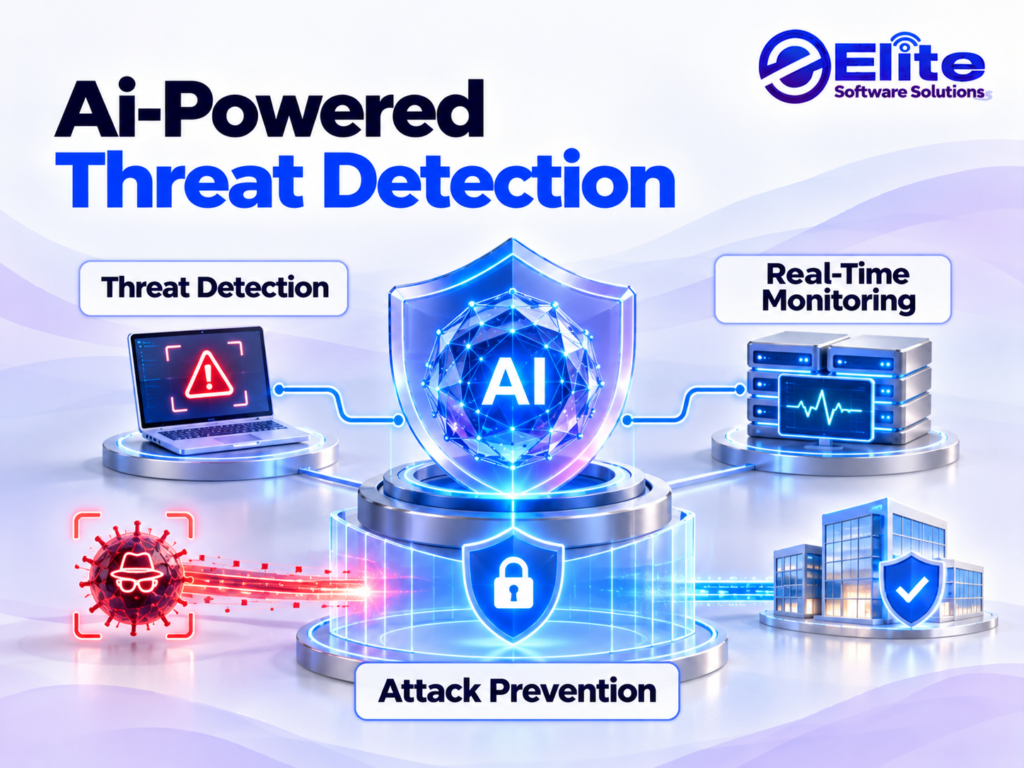
Cyberattacks are becoming harder to detect, faster to execute, and more difficult to contain. Today’s businesses face threats that go well beyond traditional malware and phishing. Attackers increasingly rely on automation, stolen credentials, social engineering, and sophisticated techniques to access business systems. Often, a security incident begins with activity that appears entirely legitimate, making it difficult for conventional security tools to recognize a threat before damage occurs.
These developments are reshaping how organizations approach cybersecurity. Rather than relying solely on predefined rules and known threat signatures, security teams are turning to artificial intelligence to analyze activity, recognize unusual patterns, and identify potential threats as they emerge. AI helps security professionals examine large volumes of security data, connect seemingly unrelated events, and prioritize incidents that warrant immediate attention.
In 2026, AI’s role in cybersecurity extends well beyond threat detection. Modern systems can help investigate alerts, recommend containment measures, and coordinate key steps in the incident response process. More advanced approaches, including agent-based AI, are also enabling security workflows to take action within clearly defined permissions and oversight frameworks.
AI, however, is neither a replacement for experienced security professionals nor a guarantee against cyberattacks. Its effectiveness depends on data quality, the strength of security controls, integration with existing systems, and appropriate human oversight. Understanding how AI threat detection works can help businesses make informed decisions about strengthening their cybersecurity strategies.
What Is AI Threat Detection in Cybersecurity?
AI threat detection uses artificial intelligence and machine learning technologies to identify suspicious activity, recognize potential security incidents, and support cyber threat investigations. These systems analyze information from multiple sources, including network traffic, user accounts, endpoints, applications, cloud environments, and security logs.
Traditional security tools typically rely on predefined rules, known attack signatures, and manually configured thresholds. These methods remain essential, particularly when identifying known threats. However, they can be less effective when attackers change their techniques, use legitimate credentials, or carry out activities that do not match previously identified attack patterns.
AI-based detection adds a valuable layer of analysis. Machine learning models can learn what normal activity looks like across an environment and identify deviations that may signal suspicious behavior. For example, an employee account that suddenly accesses an unusual set of files, logs in from an unexpected location, and transfers a large volume of data may require investigation.
A single event may not be enough to confirm an attack. Part of AI’s value lies in its ability to assess multiple signals together, helping security teams determine whether an activity presents a genuine risk.
Why AI Threat Detection Matters in 2026
The cybersecurity landscape is evolving alongside the technologies businesses rely on to operate. Cloud platforms, remote work, connected applications, APIs, mobile devices, and third-party integrations have expanded the number of potential entry points into enterprise systems.
Meanwhile, attackers are using automation to conduct reconnaissance, test stolen credentials, distribute malicious content, and adapt their tactics. This puts pressure on security teams, which must monitor more activity without necessarily having additional staff or time to investigate every alert.
AI helps address this challenge through faster analysis and more consistent monitoring. It can process large amounts of security information and identify patterns that may be difficult to recognize through manual review alone.
The growing complexity of identity-based attacks is another important consideration. A compromised account may allow an attacker to move through systems using legitimate access rather than obviously malicious software. Detecting this type of activity requires an understanding of user behavior, access patterns, device information, and the context surrounding each action.
For businesses, AI threat detection can provide greater visibility across these environments. It can help security teams identify suspicious behavior sooner, shorten investigation times, and focus their attention on incidents with the greatest potential impact.
How AI Identifies Cyberattacks
AI-powered cybersecurity systems use a range of analytical techniques to identify suspicious activity. Most enterprise environments combine several methods rather than relying on a single model or detection approach.
Behavioral Analysis and Anomaly Detection
Behavioral analysis looks at how users, devices, applications, and systems typically operate. AI models can learn from historical activity and use those patterns to identify behavior that falls outside expected norms.
For example, a finance employee may normally access accounting applications during business hours and work with a predictable range of financial records. If the same account begins accessing administrative systems late at night, downloading unusual volumes of information, or attempting to reach restricted resources, the activity may trigger an alert.
Anomaly detection is especially useful when an attack does not match a known threat signature. However, unusual behavior is not necessarily malicious. A legitimate business process, employee travel, or system update can also create unexpected patterns. Security teams must therefore assess alerts in the context of other available information.
Machine Learning for Threat Classification
Machine learning enables cybersecurity platforms to classify activity based on patterns in historical and current security data. Models can be trained to recognize characteristics associated with malicious files, suspicious network connections, phishing messages, and other attack indicators.
For instance, an email security system may examine sender information, message structure, links, attachments, and other signals to estimate whether a message is malicious. Endpoint security tools may analyze process behavior, file activity, and system changes to identify potentially harmful execution.
These models can improve detection when they receive relevant data and are maintained appropriately. Performance still depends on training quality, accurate data labels, the evolving threat landscape, and regular model evaluation.
Natural Language Processing for Phishing Detection
Phishing remains one of the most common ways attackers gain access to business systems. Attackers may imitate executives, suppliers, financial institutions, or trusted service providers to persuade employees to reveal information or take an unsafe action.
Natural language processing allows security systems to examine the language and context of messages. It can identify suspicious wording, unusual requests, misleading links, and inconsistencies between a message’s content and its apparent sender.
Today’s phishing attempts may be grammatically polished and highly personalized, making spelling mistakes an unreliable warning sign on their own. AI-based email analysis can provide additional context, but employees still need clear reporting procedures and security awareness training.
Threat Intelligence Correlation
A security event may appear harmless when viewed on its own. Its significance often becomes clearer when it is assessed alongside external threat intelligence and other internal events.
AI-enabled security platforms can correlate information such as suspicious IP addresses, domain activity, file hashes, vulnerability information, and endpoint alerts. This helps security teams connect related signals and investigate potential attack activity across multiple systems.
For example, a suspicious login may become more concerning when the same account is associated with unusual privilege changes and connections to infrastructure already identified in threat intelligence feeds.
Correlation gives security teams a more complete picture of an incident instead of treating each alert as an isolated event.
How AI Helps Prevent Cyberattacks
Detecting suspicious activity is only one element of a comprehensive cybersecurity strategy. Organizations must also respond quickly to limit exposure and prevent an incident from spreading.
AI can strengthen preventive security by helping teams identify weaknesses, recognize risky activity, and carry out approved response procedures. The appropriate level of automation should reflect system sensitivity and the potential consequences of an incorrect action.
Identifying Vulnerabilities and Security Weaknesses
AI-assisted security tools can analyze vulnerability information, asset inventories, configuration data, and available threat intelligence. This helps teams prioritize weaknesses according to their exposure and potential impact.
For example, a vulnerability affecting an internet-facing application may require more urgent attention than an issue in an isolated test environment. AI can help organize these findings and provide context, but security teams should validate the results and make remediation decisions using business risk, exploitability, and operational requirements.
Detecting Suspicious Access and Account Misuse
Identity security is central to modern threat prevention. Attackers frequently target passwords, session tokens, privileged accounts, and authentication workflows.
AI-based monitoring can flag unusual login patterns, unexpected privilege escalation, unfamiliar device activity, and access attempts that deviate from normal behavior. When integrated with identity and access management systems, these signals can support actions such as requiring additional authentication or temporarily restricting a session.
Any such response should follow clearly defined policies. Automatically blocking an account without considering business context can disrupt legitimate operations, particularly in healthcare, finance, and other environments where access to critical systems must remain available.
Supporting Automated Incident Response
When a security incident is detected, AI can gather relevant evidence, summarize alerts, identify affected assets, and recommend next steps. Integration with security orchestration, automation, and response platforms can also allow approved actions to be executed across connected tools.
For example, a confirmed malicious endpoint may be isolated from the network while an investigation begins. A suspicious email may be removed from additional mailboxes, or a compromised session may be revoked.
A reliable approach clearly defines which actions can be automated and which require human approval. High-impact actions, such as disabling critical infrastructure or changing production access policies, should have stronger authorization and review requirements.
The Role of Agentic AI in Cybersecurity
Traditional AI security tools typically focus on analyzing data, identifying patterns, and generating alerts.Agentic AI introduces a different approach by allowing AI agents to work through defined tasks, use connected tools, and coordinate multiple steps toward an objective.
In cybersecurity, an AI agent might receive a suspicious activity alert, collect relevant endpoint and identity information, review associated threat intelligence, and prepare an investigation summary. Depending on its permissions, it may also initiate an approved response workflow or request human authorization before taking further action.
This approach can reduce repetitive investigation work and improve coordination across security systems. However, agentic AI also introduces new risks. An agent with excessive permissions could make an incorrect change, expose sensitive information, or be manipulated through malicious instructions embedded in the data it processes.
Businesses exploring agentic AI in cybersecurity should carefully evaluate security boundaries, access controls, audit trails, approval requirements, and the ability to stop or reverse actions. Agents should receive only the permissions necessary for their assigned tasks, and their decisions should remain observable and reviewable.
The objective is not to give AI unrestricted control over cybersecurity operations. It is to use carefully governed automation to help security professionals investigate and respond more effectively.
Practical Applications of AI Threat Detection Across Industries
AI threat detection is relevant to nearly every industry that relies on digital systems. However, risks and security priorities vary based on the information an organization handles and the services it delivers.
Banking and Financial Services
Banks and financial institutions manage sensitive customer information, payment systems, digital accounts, and high-value transactions. AI can help identify unusual transaction patterns, suspicious account access, potential fraud, and attempts to misuse privileged credentials.
For example, a transaction that differs significantly from a customer’s normal activity may trigger additional verification. Security systems can also examine login behavior and device information to identify signs of account compromise. These capabilities can strengthen fraud monitoring, although decisions involving legitimate customer transactions should account for the risk of false positives.
Healthcare Organizations
Healthcare providers rely on electronic health records, medical applications, connected devices, and systems that support clinical operations. A cyberattack can affect patient privacy and disrupt access to important services.
AI can help monitor access to patient records, identify unusual network activity, and detect suspicious behavior across connected systems. It can also help security teams investigate potential ransomware activity and identify devices that may be communicating with malicious infrastructure.
Healthcare organizations must balance security with availability. Automated responses should not interrupt access to critical clinical systems without appropriate safeguards and human oversight.
Retail and E-Commerce
Retail businesses handle customer accounts, payment information, inventory platforms, supplier integrations, and online transactions. These environments can attract attacks involving account takeover, payment fraud, credential theft, and malicious activity against e-commerce applications.
AI-powered monitoring can identify unusual login attempts, suspicious checkout behavior, automated account creation, and unexpected changes to application activity. By connecting information across customer-facing platforms and internal systems, security teams can investigate threats that might otherwise remain unnoticed.
Manufacturing and Critical Infrastructure
Manufacturing environments increasingly connect operational technology with enterprise networks and cloud-based platforms. This creates additional security considerations because an attack may affect production equipment, industrial control systems, or essential business operations.
AI can help monitor network communication, identify unusual device behavior, and detect unexpected changes in operational environments. However, industrial systems require particularly careful implementation. Security monitoring and automated responses must account for equipment safety, production requirements, and the potential consequences of disrupting operations.
AI Threat Detection vs. Traditional Cybersecurity
AI does not make traditional cybersecurity tools obsolete. Both approaches play an important role in a well-designed security program.
| Area | Traditional security tools | AI-enabled security |
| Detection | Often uses predefined rules and known signatures | Can identify patterns and unusual behavior |
| Analysis | May require manual correlation across alerts | Can correlate multiple signals and prioritize investigations |
| Adaptability | Depends heavily on rule and signature updates | Models can be updated and retrained as conditions change |
| Response | Often relies on predefined workflows and human action | Can recommend or execute approved automated actions |
| Limitations | May miss unfamiliar or context-dependent activity | Can produce false positives and incorrect predictions |
Traditional tools remain valuable for enforcing access policies, blocking known malicious files, and applying established security rules. AI adds analytical capabilities that can help identify less obvious threats.
A mature cybersecurity strategy brings these technologies together rather than treating them as competing alternatives. Organizations should evaluate how AI improves their existing security controls and whether its results are reliable enough for the decisions it is expected to support.
Challenges of Using AI for Cybersecurity
Although AI offers significant benefits, successful implementation requires careful planning. Businesses should understand its limitations before relying on AI-generated alerts or automated actions.
False Positives and False Negatives
AI systems may classify legitimate activity as suspicious or fail to identify a genuine attack. Too many false positives can overwhelm security teams, while false negatives can allow threats to remain undetected.
Organizations should regularly evaluate detection performance using relevant security data and investigate how models behave when business activity changes. Human review remains essential, particularly when incidents carry significant risk.
Data Quality and Privacy
AI-based detection is only as reliable as the information available to it. Incomplete logs, inconsistent data, missing context, or poorly configured integrations can affect the accuracy of its findings.
Security data may also include personal information, confidential business records, and sensitive operational details. Businesses must establish appropriate data access policies, retention practices, encryption controls, and privacy safeguards before connecting information to AI systems.
Adversarial Attacks Against AI Systems
Attackers may try to manipulate AI models or the information those models process. Techniques such as data poisoning, evasion, and prompt injection can interfere with AI-driven workflows.
This risk is particularly important when AI agents can access security tools, retrieve information, or initiate actions. Organizations should validate input sources, restrict tool permissions, separate untrusted content from operational instructions, and maintain clear approval controls.
Integration With Existing Security Infrastructure
Many organizations already rely on security information and event management platforms, endpoint detection tools, identity systems, firewalls, and cloud security services. Introducing AI into this environment requires careful, reliable integration.
Poorly planned integrations can create duplicate alerts, inconsistent information, and gaps in monitoring. Businesses should evaluate compatibility, data flows, access permissions, and operational responsibilities before deploying new capabilities.
Governance and Accountability
AI-generated security decisions must be sufficiently transparent for security teams to review and act on them. Organizations need to know which data influenced an alert, which system initiated a response, and who approved consequential actions.
For a deeper look at this subject, read our earlier article,Agentic AI Security: Risks & Governance for Enterprises. It explores the security and governance considerations that become especially important when autonomous AI systems are introduced into enterprise environments.
Best Practices for Implementing AI Threat Detection
Successful implementation starts with a clear understanding of the security challenges an organization needs to address. Instead of introducing AI across every system at once, businesses should begin with high-priority use cases, such as suspicious account activity, endpoint monitoring, phishing detection, or cloud security analysis.
The next step is to build a reliable data collection process. Security teams should review whether logs from endpoints, networks, applications, cloud services, and identity platforms are complete and accessible. Consistent data and clear asset inventories help AI systems provide more meaningful results.
Organizations should also define how alerts will be evaluated and how automated actions will be authorized. Low-risk activities may be suitable for automation after testing, while decisions that could interrupt critical services or expose sensitive information should require human approval.
Ongoing testing is just as important. Detection models and response workflows should be evaluated against realistic attack scenarios, changing business activity, and newly identified threats. Teams should measure whether AI is improving detection quality and investigation efficiency rather than assuming that automation automatically produces better security.
Finally, businesses should train security professionals to work effectively with AI tools. Employees need to understand how to interpret model outputs, recognize unreliable recommendations, investigate unexpected behavior, and escalate incidents through established procedures.
What Businesses Should Consider When Choosing an AI Cybersecurity Solution
Choosing an AI cybersecurity solution involves more than comparing product features. Businesses should examine how well a platform fits their existing infrastructure and the specific risks they need to manage.
Detection quality should be a primary consideration. Organizations should understand what types of threats a platform can identify, what data it requires, and how it handles unfamiliar activity. They should also ask how the vendor evaluates model performance and communicates limitations.
Integration capabilities matter because security information is often distributed across multiple tools. A solution should work with relevant identity providers, endpoint platforms, cloud services, network controls, and incident response systems without creating unnecessary complexity.
Privacy and governance should also influence the decision. Businesses need clarity about where security data is processed, who can access it, whether information is used to train external models, and how long records are retained. For systems that support automated response, permission boundaries and auditability should be evaluated before deployment.
The best solution is not necessarily the one with the most advanced AI features. It is the one that addresses real security needs, fits operational requirements, and provides reliable results that security teams can verify.
The Future of AI Threat Detection
AI will continue to shape how organizations monitor and respond to cyber threats. Security platforms are increasingly combining machine learning, behavioral analytics, threat intelligence, and automation to provide a broader view of potential incidents.
Agent-based systems may take on more structured investigation tasks, including gathering evidence, connecting related alerts, and coordinating approved response workflows. This could reduce repetitive work and give security professionals more time to focus on complex incidents.
At the same time, organizations will need to protect AI systems themselves. As businesses connect models and agents to sensitive data and operational tools, AI security, identity management, access control, and governance will become increasingly important parts of cybersecurity planning.
The future is unlikely to center on fully autonomous security operations. More realistically, it will involve closer collaboration between AI systems and experienced security professionals, with automation handling appropriate tasks and people retaining oversight of important decisions.
Conclusion
AI threat detection is becoming an increasingly important part of modern cybersecurity. It helps organizations analyze large volumes of security information, identify unusual activity, and respond to potential threats more efficiently. From detecting suspicious logins and phishing attempts to supporting incident investigations, AI can strengthen the capabilities of security teams across industries.
Effective cybersecurity, however, requires more than deploying an AI tool. Businesses must pay attention to data quality, system integration, privacy, model reliability, and human oversight. They should also establish clear boundaries before allowing AI systems to take action.
In 2026, the most effective approach is to combine established security controls with carefully governed AI capabilities. Organizations that adopt this approach can improve their ability to identify emerging threats while keeping security decisions accountable, controlled, and aligned with business priorities.
Frequently Asked Questions
1. What is AI threat detection in cybersecurity?
AI threat detection uses machine learning, behavioral analysis, and other AI techniques to identify suspicious activity, recognize potential attacks, and help security teams investigate threats. It can analyze information from networks, endpoints, applications, and user accounts.
2. How does AI detect cyberattacks?
AI examines security data to identify unusual patterns, suspicious behavior, and indicators associated with known threats. It can correlate multiple events to help identify potential attacks that might be difficult to recognize through individual alerts.
3. Can AI prevent cyberattacks automatically?
AI can support automated prevention and response, including isolating compromised devices, flagging suspicious access, and initiating approved security workflows. However, organizations should define permissions and require human approval for actions that could affect critical systems.
4. What is the role of Agentic AI in cybersecurity?
Agentic AI can help coordinate multi-step security tasks, such as collecting evidence, investigating alerts, reviewing threat intelligence, and initiating approved response procedures. Its actions should remain within clearly defined permissions and governance controls.
5. Is AI better than traditional cybersecurity tools?
AI and traditional security tools serve complementary purposes. Traditional tools enforce established security rules and identify known threats, while AI can help recognize unusual behavior and connect complex signals. Combining both approaches generally provides broader protection.
6. What are the main challenges of AI threat detection?
Key challenges include false alerts, incomplete data, privacy concerns, adversarial attacks, integration difficulties, and governance requirements. Organizations need ongoing testing and human oversight to manage these risks.
7. Which industries benefit from AI-powered threat detection?
Banking, healthcare, retail, manufacturing, financial services, and other industries can benefit from AI-powered threat detection. Any organization managing sensitive information or relying on connected digital systems can use AI to strengthen its security monitoring.