
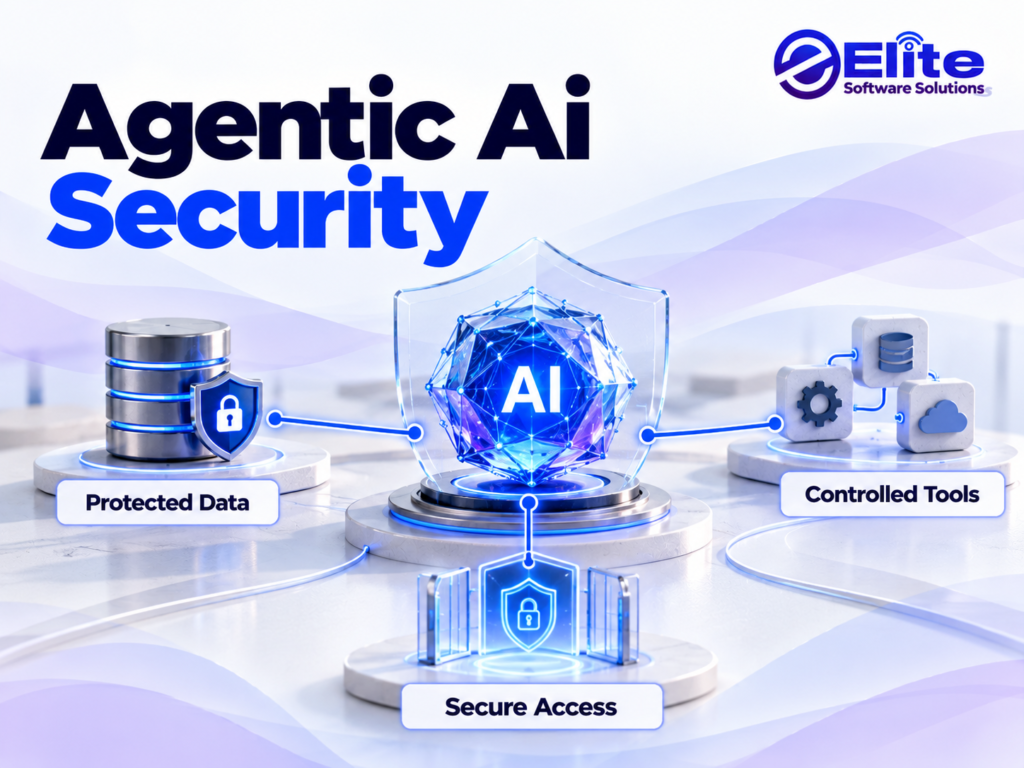
Agentic artificial intelligence is changing how businesses automate workflows, coordinate tasks, and interact with enterprise systems. Unlike traditional AI applications that primarily generate content or respond to questions, AI agents can plan tasks, use tools, retrieve information, and execute multi-step workflows with varying levels of autonomy.
However, greater autonomy introduces new security challenges. An agent connected to business applications may access confidential records, invoke APIs, update databases, or initiate operational processes. If its instructions are manipulated, its permissions are excessive, or its actions are not properly validated, a single weakness can expose sensitive information or trigger unintended business consequences.
In 2026, agentic AI security is becoming an important consideration for organizations moving AI agents from experimental projects into production environments. Protecting these systems requires more than securing the underlying language model. Businesses must also control agent identities, data access, tools, memory, integrations, and decision-making boundaries.
This guide explores the major agentic AI security risks, implementation challenges, and best practices enterprises can use to develop and operate more secure AI-powered systems.
What Is Agentic AI Security?
Agentic AI security refers to the technical safeguards, governance policies, monitoring mechanisms, and operational procedures used to protect AI agents and the systems they interact with.
An AI agent may receive a business objective, divide it into smaller tasks, select appropriate tools, retrieve relevant information, and take actions based on its observations. Depending on its design, it may also retain context, delegate tasks to other agents, or continue working across multiple stages without requiring approval at every step.
This creates a broader security boundary than a conventional chatbot. Organizations must protect the model and its inputs while also securing the agent’s permissions, external tools, data sources, memory, and ability to execute actions.
Effective agentic AI security combines secure software architecture with identity management, access control, data protection, runtime monitoring, and human oversight. The objective is not to eliminate automation but to ensure that an agent’s actions remain within clearly defined technical, operational, and business boundaries.
Why Agentic AI Security Matters in 2026
Enterprises are exploring agentic AI for customer support, software development, financial operations, healthcare administration, document processing, and internal workflow automation. These applications can reduce repetitive work and improve operational efficiency, but their ability to interact with business systems also creates additional exposure.
From AI Recommendations to Real-World Actions
A conventional AI assistant might recommend updating a customer record. An agent with suitable tool access could attempt to make that change directly. If its instructions are manipulated or its permissions are too broad, the consequences may extend beyond an inaccurate answer.
Multiple Integrations Increase the Attack Surface
Enterprise agents often connect to databases, email platforms, document repositories, customer relationship management systems, and third-party APIs. Each integration introduces potential weaknesses involving authentication, authorization, data handling, and input validation.
Errors Can Spread Across Automated Workflows
In a multi-step workflow, an incorrect assumption can influence subsequent decisions. If later actions are not independently validated, an initial mistake may result in inaccurate communications, unauthorized record changes, or additional operational errors.
Governance Must Keep Pace With Deployment
Security teams need visibility into which agents exist, who owns them, what resources they can access, and which actions they are authorized to perform. Without clear ownership and monitoring, organizations may struggle to investigate incidents or demonstrate that security policies are being followed.
The central challenge is to make AI agents productive while ensuring that their authority remains limited, traceable, and appropriate to their responsibilities.
Key Agentic AI Security Risks Enterprises Must Address
The OWASP Top 10 for Agentic Applications for 2026 identifies major risks associated with autonomous AI systems, including goal hijacking, tool misuse, privilege abuse, supply-chain vulnerabilities, and cascading failures. These risks provide a practical foundation for enterprise threat assessments.
OWASP Gen AI Security Project+1
Agent Goal Hijacking and Prompt Injection
Prompt injection occurs when malicious or untrusted content influences an AI system to follow instructions that conflict with its intended purpose. An agent may encounter such content in emails, uploaded documents, web pages, retrieved knowledge, or tool responses.
For example, a customer-support agent reviewing an email could encounter hidden instructions intended to make it disclose confidential information or initiate an unauthorized action. The risk becomes more serious when the agent has access to business tools and can act on the manipulated instructions.
Organizations should treat external content as untrusted data, separate user instructions from retrieved information, validate proposed actions against application-level policies, and require approval for sensitive operations. Prompt filtering can help, but it should not be treated as the sole defense.
Tool Misuse and Exploitation
AI agents use tools to retrieve records, interact with applications, execute code, and initiate workflows. A legitimate tool can become dangerous when an agent invokes it with incorrect parameters, excessive authority, or an inappropriate objective.
An agent connected to a finance platform, for instance, might attempt to initiate a payment or alter a record when its intended role is limited to preparing recommendations.
Businesses should maintain an approved catalog of tools, validate parameters on the server, restrict operations by business context, and enforce transaction limits. Read-only and write permissions should be separated wherever practical, while high-impact actions should require explicit authorization outside the model.
Identity and Privilege Abuse
An agent may operate using a user’s identity or a dedicated service account. If permissions are too broad, an agent could access information or perform operations beyond its assigned responsibilities. Shared credentials can also make it difficult to identify which agent performed an action and whether the action was authorized.
A stronger approach gives agents distinct identities where practical, uses short-lived credentials, and applies least-privilege access. Authorization should be checked whenever an agent requests an operation, with logs recording the initiating user, agent identity, requested action, and authorization outcome.
Agentic Supply-Chain Vulnerabilities
Enterprise agents depend on models, software libraries, plugins, connectors, external services, and third-party tools. A compromised dependency or untrusted update can introduce weaknesses into an otherwise secure system.
Organizations should assess dependencies before deployment, verify component provenance, monitor versions, scan for vulnerabilities, and test updates before releasing them into production. Third-party integrations should receive only the permissions needed for their specific functions.
Unexpected Code Execution
Some agents can generate code, execute scripts, or interact with development environments. Running generated code without adequate isolation could expose credentials, alter files, access internal services, or disrupt production systems.
Businesses should execute untrusted code in isolated environments, restrict filesystem and network access, keep secrets out of execution contexts, and enforce resource limits. Generated code should be reviewed and tested before it can affect critical systems.
Memory and Context Poisoning
AI agents may rely on conversation history, persistent memory, retrieval-augmented generation, or vector databases to maintain context. If malicious or inaccurate information enters these sources, it can influence future responses and actions.
For example, an agent could retrieve a manipulated internal document that falsely identifies an unauthorized account as an approved payment destination. The agent might then use that information in a subsequent workflow.
Organizations should apply access controls to memory and knowledge stores, preserve source attribution, validate important facts against authoritative systems, and establish retention policies. Memory updates and knowledge ingestion should also undergo integrity checks appropriate to the sensitivity of the system.
Insecure Communication Between Agents
Multi-agent architectures allow specialized agents to delegate tasks and share information. However, weak authentication, insufficient message validation, or unclear trust relationships can allow one agent to influence another improperly.
A compromised research agent, for example, might send misleading instructions to an operations agent with permission to modify enterprise records. The receiving agent should not assume that an instruction is trustworthy simply because it came from another internal agent.
Secure implementations authenticate agent identities, protect message integrity, validate message formats, restrict delegation, and independently authorize consequential actions.
Cascading Agent Failures
An agent’s output may become another agent’s input, creating a chain of automated decisions. If an early step produces incorrect information or triggers an unintended action, later steps may amplify the error.
In an order-processing workflow, an inaccurate inventory estimate could lead to incorrect purchasing decisions, customer notifications, and downstream accounting changes.
Organizations can limit this risk through execution limits, timeouts, circuit breakers, validation between workflow stages, and rollback or compensation procedures. Critical operations should include checkpoints rather than depending on an unrestricted chain of autonomous actions.
Human–Agent Trust Exploitation
People may overestimate an AI agent’s reliability because its recommendations appear confident or authoritative. This can lead users to approve actions without examining the evidence, context, or potential consequences.
Approval interfaces should clearly identify the proposed action, its target, the likely impact, and whether it can be reversed. For consequential decisions, users should have access to relevant evidence and sufficient context to make an informed decision.
Rogue Agents and Behavioral Drift
An agent may behave outside its intended scope because of compromised instructions, configuration changes, flawed objectives, unexpected tool interactions, or inadequate runtime controls. Such behavior does not imply that an AI system is conscious or intentionally malicious; it means its actions have departed from approved boundaries.
Organizations should monitor activity against defined policies, maintain an inventory of deployed agents, and provide a reliable way to suspend an agent or revoke its access. Unexpected behavior should trigger investigation and a review of the agent’s configuration, permissions, and operating environment.
Major Challenges in Securing Agentic AI Systems
Balancing Autonomy With Control
Greater autonomy can reduce manual effort, but unrestricted autonomy increases the consequences of errors. Enterprises need to decide which tasks agents may perform independently, which require human approval, and which must remain prohibited.
A practical approach is to begin with low-risk tasks and expand an agent’s authority only after its behavior and safeguards have been evaluated. This allows organizations to gather operational evidence before granting access to more sensitive workflows.
Maintaining Visibility Across Complex Workflows
A single business process may involve several agents, APIs, databases, external tools, and human approvals. Traditional application logs may not capture enough context to reconstruct why a particular action occurred.
Enterprises need traceable records of initiating requests, relevant inputs, tool calls, permission checks, approvals, and resulting changes. Those records should support investigations without unnecessarily storing secrets or sensitive personal information.
Protecting Sensitive Enterprise Data
Agents may retrieve information from sources governed by different access policies. A user authorized to ask a general question should not automatically gain access to every resource available to the agent.
Access controls must be enforced during retrieval and action execution. Data classification, redaction, tenant isolation, retention limits, and output inspection can further reduce exposure.
Testing Non-Deterministic Behavior
An agent may behave differently when its inputs, retrieved information, model version, or context changes. A successful demonstration does not establish that the agent will remain safe under adversarial or unusual conditions.
Security testing should cover prompt injection, permission-boundary violations, malicious tool responses, malformed inputs, unexpected workflow states, and attempts to expose sensitive information. Testing should be repeated after significant changes to models, prompts, tools, or policies.
Integrating Security Into Existing Governance
Agent security overlaps with cybersecurity, privacy, identity management, software engineering, risk management, and business operations. If responsibility is fragmented, important controls may be missed.
Organizations should establish clear ownership for agent approval, access management, incident response, ongoing evaluation, and retirement. The NIST AI Risk Management Framework offers a lifecycle-oriented structure for incorporating trustworthiness and risk management into AI design, development, use, and evaluation.
NIST+1
Best Practices for Securing Agentic AI in 2026
Apply Least-Privilege Access by Default
Every agent should receive only the permissions required for its assigned task. Avoid granting broad administrator access simply because it makes integration easier. Separate permissions for reading, creating, modifying, deleting, and approving records wherever possible. Access should be scoped to appropriate users, datasets, resources, and workflows, with regular reviews whenever an agent’s responsibilities change.
Establish Clear Boundaries for Autonomous Actions
Define the agent’s purpose, permitted actions, prohibited operations, and escalation conditions before deployment. These boundaries should be enforced through application logic and authorization services rather than relying exclusively on instructions in a prompt.
For example, an agent might prepare a refund recommendation but require an authorized employee to approve the actual payment. This preserves the efficiency of automation without transferring unrestricted authority to the model.
Validate Every Tool Call
Treat each proposed tool call as an untrusted request until the application validates it. The system should check the user’s authorization, the requested operation, target resource, parameter values, and relevant business rules.
Use approved tools and predefined schemas rather than allowing unrestricted access to arbitrary APIs or commands. Rate limits, transaction limits, duplicate-action protection, and server-side authorization checks can help prevent unintended operations.
Protect Data Throughout the Agent Lifecycle
Security controls should apply when information enters the system, is retrieved, processed by a model, stored in memory, and returned to a user or external application.
Organizations should classify sensitive information, enforce source-level permissions, minimize the data sent to models, and apply appropriate encryption and retention controls. They should also assess whether model providers, external tools, and monitoring services receive information they do not need.
Implement Human Approval for High-Impact Actions
Human oversight is particularly important when an action could cause financial loss, expose confidential information, change critical records, affect customers, or create difficult-to-reverse consequences.
Approval should apply to the exact action being authorized. If an agent subsequently changes a recipient, transaction amount, target record, or another material parameter, the system should require renewed authorization.
Secure Agent Memory and Retrieval Systems
Stored information should not become trusted simply because an agent has encountered it previously. Organizations should track data provenance, enforce access controls, and distinguish verified business facts from user-provided claims and model-generated assumptions.
For retrieval-augmented generation, document permissions should be preserved throughout retrieval and response generation. Persistent memory should also be reviewed for inappropriate retention, stale information, and malicious content that could influence future actions.
Monitor Agents at Runtime
Pre-deployment testing cannot anticipate every production condition. Runtime monitoring should detect unusual tool usage, unexpected access attempts, repeated failures, policy violations, abnormal resource consumption, and activity outside an agent’s assigned purpose.
Depending on the severity of an event, the system should be able to block a tool call, request approval, reduce permissions, or suspend the agent. Logging should support investigations while protecting credentials, personal information, and confidential business data.
Build Incident Response and Recovery Into the Design
Organizations need a defined response when an agent behaves unexpectedly or a supporting component is compromised. Security teams should be able to revoke credentials, disable tools, pause workflows, isolate affected systems, and determine which actions have already occurred.
For critical business processes, recovery procedures should include rollback or compensating transactions wherever feasible. Suspending an agent prevents further actions but does not automatically reverse changes it has already made.
Secure the Development and Deployment Pipeline
Use secure coding practices, dependency scanning, secrets management, code review, environment separation, and controlled release processes. Evaluate agent prompts, tool definitions, policies, model configurations, and integration changes as part of the release lifecycle.
Development, testing, and production environments should use separate credentials and appropriate permissions. Changes that affect an agent’s autonomy or access to sensitive resources should receive security review before deployment.
Establish Ongoing Governance and Accountability
Maintain an inventory of agents, business owners, technical owners, approved tools, accessible data, risk classifications, and deployment status. Define who can create, approve, modify, suspend, and retire each agent.
Regular reviews should account for changes in the threat environment, business requirements, models, dependencies, and applicable obligations. Governance should remain active after launch rather than ending when an agent passes its initial assessment.
A Practical Agentic AI Security Framework for Enterprises
Enterprises can make security more manageable by integrating it into each stage of an agent’s lifecycle.
Discover and Classify
Begin by identifying the agents in use, their business purposes, their connected systems, and the information they can access. Assess the potential consequences of misuse, failure, or unauthorized actions so that security requirements reflect the actual risk.
Design Security Boundaries
Define agent identities, least-privilege permissions, approved tools, action limits, approval requirements, and prohibited operations before implementation. Establish how the system will validate requests and prevent the model from bypassing application-level controls.
Test Adversarial Scenarios
Evaluate prompt injection, unauthorized access, malicious retrieved content, tool misuse, data leakage, and cascading failures in a controlled environment. Test both individual components and complete workflows, including interactions between agents.
Deploy With Monitoring
Release agents gradually, beginning with appropriately scoped tasks. Monitor actual behavior, record security-relevant events, validate actions against established policies, and provide a reliable mechanism to suspend the agent or revoke its access.
Review and Improve
Reassess permissions, test significant changes, investigate incidents, update threat models, and retire agents or integrations that no longer meet business and security requirements. Each stage should produce evidence that relevant controls have been implemented and tested.
This lifecycle approach helps organizations treat security as an ongoing engineering responsibility rather than a final checklist before launch.
How to Choose an AI Agent Development Company With Security Expertise
Selecting a development partner is an important decision when an agent will access enterprise data or execute business operations. A provider should demonstrate not only AI engineering capabilities but also the ability to build authorization, validation, monitoring, and recovery into the solution.
When evaluating an ai agent development company, businesses should examine how the provider handles identity management, least-privilege access, tool authorization, prompt injection, sensitive data, agent memory, and human approval. The provider should explain how security controls are enforced outside the model and how the system responds when an agent attempts an unauthorized action.
A qualified development partner should also demonstrate a structured approach to adversarial testing, dependency management, secure deployment, audit logging, and incident response. Documented architecture, security test results, and clearly assigned operational responsibilities offer stronger evidence of readiness than a product demonstration alone.
Businesses should also assess whether the proposed solution can scale without introducing excessive permissions or weakening existing security policies. The right partner will align the agent’s capabilities with the organization’s risk tolerance and business objectives instead of treating security as an afterthought.
Agentic AI Security and Enterprise Governance
Technical safeguards are only one part of a dependable agentic AI strategy. Enterprises also need clear ownership, risk assessment, access policies, incident procedures, and ongoing oversight to ensure that autonomous systems remain accountable.
For a deeper discussion of these organizational considerations, read Agentic AI Security: Risks & Governance for Enterprises. This related article explores agent security risks and the governance practices organizations should consider when deploying autonomous AI systems.
Connecting implementation-level controls with enterprise governance helps businesses ensure that AI agents remain aligned with approved policies throughout their operational life.
Conclusion
Agentic AI can help enterprises automate complex workflows, coordinate tasks, and make better use of business information. However, agents that can use tools, access data, and execute actions introduce security risks that extend beyond conventional AI output quality.
The most important safeguards include least-privilege access, explicit action boundaries, secure tool integrations, protected memory, adversarial testing, runtime monitoring, human approval for high-impact actions, and tested incident-response procedures.
Organizations should establish these controls before expanding an agent’s autonomy and continue evaluating them as the system evolves. By combining secure engineering with clear governance, enterprises can adopt agentic AI more responsibly while keeping its actions aligned with business requirements.
Frequently Asked Questions
What Is Agentic AI Security?
Agentic AI security is the practice of protecting AI agents, their data, tools, identities, workflows, and connected systems from misuse, unauthorized access, manipulation, and operational failures. It combines technical safeguards with organizational governance.
What Are the Biggest Agentic AI Security Risks in 2026?
Major risks include agent goal hijacking, tool misuse, identity and privilege abuse, supply-chain vulnerabilities, unexpected code execution, memory poisoning, insecure communication between agents, cascading failures, human–agent trust exploitation, and rogue-agent behavior. These categories are covered in the OWASP Top 10 for Agentic Applications for 2026.
OWASP Gen AI Security Project+1
How Can Businesses Prevent Prompt Injection in AI Agents?
Businesses should treat retrieved documents and external content as untrusted, separate instructions from data, validate proposed actions against application-level policies, restrict tool permissions, and require approval for sensitive operations. Prompt filtering can help, but no single filter eliminates prompt-injection risk.
Why Is Least-Privilege Access Important for AI Agents?
Least-privilege access limits the resources and operations available to an agent. If the agent is manipulated or makes an error, narrowly scoped permissions can reduce the potential impact and help prevent unauthorized access to sensitive systems.
Should AI Agents Require Human Approval?
Not for every action. Approval requirements should reflect the potential impact and reversibility of an operation. High-risk activities, such as transferring funds, changing sensitive records, or disclosing confidential information, often warrant explicit authorization.
How Should Enterprises Monitor AI Agent Activity?
Enterprises should record relevant tool calls, permission checks, approvals, security events, and resulting actions. They should also detect unusual behavior and maintain the ability to block actions, revoke credentials, or suspend an agent. Logging should be designed to avoid unnecessary exposure of sensitive information.
Which Frameworks Help Organizations Manage Agentic AI Security?
The OWASP Top 10 for Agentic Applications helps organizations identify agent-specific threats, while the NIST AI Risk Management Framework provides a broader structure for managing AI risks throughout the lifecycle. Organizations should adapt these resources to their systems, risk profiles, and applicable obligations.
OWASP Gen AI Security Project+1
When Should a Business Conduct an Agentic AI Security Assessment?
An assessment should begin during design, before an agent receives access to sensitive systems. It should be repeated before major releases, after significant changes to models, tools, permissions, data sources, or workflows, and following security incidents.