
Introduction
Artificial intelligence is becoming increasingly integrated into enterprise software, but its business value depends on how well it understands business processes, data, roles, and workflows. SAP Joule is designed around this principle. Rather than functioning only as a general-purpose chatbot, Joule is SAP’s AI copilot, built to help users find information, understand business context, and complete supported tasks using natural-language interactions.
SAP introduced Joule as a generative AI assistant and has continued expanding its capabilities across SAP applications and business processes. Its development now extends beyond conversational assistance into AI agents and assistants designed to coordinate tasks and workflows. SAP describes Joule Agents as context-aware AI agents with business-process expertise that can automate workflows at scale.
For organizations already using SAP or considering enterprise AI adoption, understanding SAP Joule AI is important because it represents a shift from simply navigating business software toward interacting with business processes through conversational and increasingly agentic AI.
What Is SAP Joule?
SAP Joule is an AI copilot from SAP that allows users to interact with business applications and information using natural language. Instead of manually navigating through multiple menus or searching across enterprise systems, users can express what they need conversationally and receive relevant information or assistance within supported SAP environments.
Joule is designed around SAP’s business-process context and connected enterprise ecosystem. Its capabilities can support different business functions and applications, depending on the SAP environment, available products, and specific Joule capabilities enabled by an organization.
This makes Joule different from a standalone generative AI chatbot. Its purpose is not simply to generate text. It is designed to help users interact with enterprise information and applications while supporting business processes and workflows.
3 Key Facts About SAP Joule AI
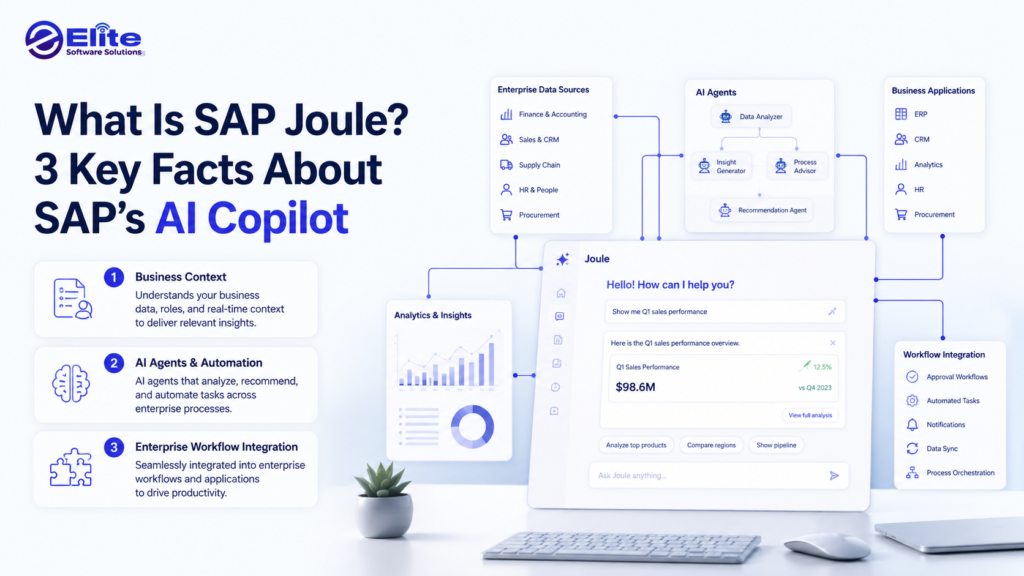
1. Joule Is Designed Around Business Context
One of the most important characteristics of SAP Joule is its focus on business context.
General-purpose AI models can answer questions based on the information available to them, but enterprise users often need answers that consider specific business processes, organizational data, permissions, and relationships between different systems.
SAP’s Joule strategy is built around this requirement. SAP describes Joule Agents and Assistants as context-aware capabilities that use business-process expertise and role and process context to coordinate actions.
This contextual approach is particularly important for enterprise environments. A finance professional, for example, may not simply need a definition of a financial metric. They may need to understand what that metric means within their organization’s actual business processes and data.
For organizations looking to combine SAP applications with broader digital transformation initiatives, SAP solutions can provide a foundation for connecting enterprise applications, data, AI capabilities, and business workflows.
The important point is that AI becomes more useful when it understands the environment in which a business operates. Joule’s value therefore comes not only from generative AI, but from applying AI within an enterprise software context.
2. Joule Goes Beyond Chat Through AI Agents
Another major development is the evolution of Joule from an AI copilot into an environment that can coordinate AI agents.
Traditional copilots generally help users generate information, summarize content, answer questions, or perform individual actions. Agentic systems can go further by planning and executing multiple steps toward a business objective.
SAP describes Joule Agents as AI agents with business-process expertise that can automate workflows at scale. Joule Assistants can coordinate these agents using role and process context to execute more complex workflows.
For example, instead of manually gathering information from several business applications, identifying an issue, and initiating a workflow, an appropriately configured Joule environment can coordinate relevant agents and applications to support the process.
This is where AI agents become particularly significant for enterprise software. AI agents can be designed to reason through defined tasks, interact with approved tools and systems, and execute multi-step workflows within controlled boundaries.
The shift is therefore from AI that simply responds to a request toward AI that can help coordinate business actions.
3. Joule Is Becoming a Broader Enterprise AI Experience
Joule is no longer limited to being a conversational interface inside a single application. SAP is expanding it as a broader AI experience across its business ecosystem.
SAP’s current AI strategy includes Joule Work, Joule Agents, Joule Assistants, and the SAP Business AI Platform. These capabilities are designed to bring AI into business workflows while connecting relevant applications, information, and agents.
This broader direction shows that SAP’s strategy is not simply to add a chatbot to ERP software. The objective is to make AI a more integrated layer through which employees can access information, interact with applications, and support business processes.
How Does SAP Joule Work?
At a simplified level, a Joule interaction begins with a user’s request. The request is interpreted using natural-language capabilities and relevant business context. Depending on the capability being used, Joule can retrieve information, provide an answer, recommend an action, or coordinate AI agents and business applications to support workflow execution.
The important distinction is that Joule is designed to operate within an enterprise environment. SAP’s approach combines AI capabilities with business data, application context, security, governance, and business-process knowledge.
This approach can help reduce the gap between AI-generated information and actual business execution.
What Can SAP Joule Be Used For?
The practical applications of Joule vary according to the SAP products, capabilities, and services available to an organization.
Joule can support activities such as finding information, navigating SAP applications, and interacting with supported business processes through conversational interfaces. More advanced capabilities can support complex workflows involving multiple business functions and AI agents.
SAP highlights the use of Joule Agents for automating workflows and coordinating actions across business processes.
The potential business value comes from reducing repetitive navigation and manual coordination while providing employees with access to relevant information in the context of their work.
SAP Joule vs. a Traditional AI Chatbot
The distinction can be understood through the type of work each system is designed to support.
| Capability | Traditional AI Chatbot | SAP Joule |
| Natural-language interaction | Yes | Yes |
| General question answering | Yes | Yes, within supported contexts |
| Enterprise business context | Limited or externally configured | Core design principle |
| SAP application integration | Usually requires integration | Designed for supported SAP environments |
| Business workflow support | Limited | Core direction |
| AI agent coordination | May require separate systems | Supported through Joule Agents and Assistants |
| Role and process context | Limited | Central to Joule’s enterprise approach |
The key difference is therefore not simply that Joule uses generative AI. Its differentiation comes from connecting AI with enterprise applications, business processes, data, and workflows.
Why Does SAP Joule Matter for Businesses?
For organizations operating complex enterprise environments, employees can spend significant amounts of time searching for information, switching between applications, navigating menus, and coordinating multi-step processes.
An AI copilot integrated into business software can potentially reduce some of this friction. Instead of requiring users to know exactly where information is stored or which application function to open, conversational interfaces provide another way to access relevant capabilities.
Joule’s expanding agentic capabilities take this concept further by supporting workflows rather than only information retrieval. SAP states that Joule Agents are designed to automate workflows at scale and coordinate with other agents and applications.
However, businesses should evaluate AI adoption based on actual processes, data quality, governance, security, integration requirements, and measurable business outcomes rather than adopting AI simply because the technology is available.
SAP Joule and Enterprise AI Adoption
Implementing an enterprise AI copilot requires more than enabling a feature. Organizations need to understand which business processes are suitable for AI assistance, what data the AI can access, which actions require human approval, and how the system should be governed.
This is especially important when AI moves from answering questions to taking actions. The greater the level of automation, the more important permissions, monitoring, data governance, and human oversight become.
Organizations should therefore approach SAP Joule as part of a broader enterprise AI strategy rather than as an isolated chatbot implementation.
What Are the Benefits of SAP Joule?
The potential benefits of SAP Joule can be grouped into several areas.
Faster access to information: Users can interact with business information using natural language rather than manually searching through multiple screens.
Reduced process friction: Conversational interactions can simplify supported tasks and reduce unnecessary navigation.
Better business context: Joule is designed around SAP’s enterprise applications and business-process environment.
Workflow automation: Joule Agents can support multi-step business workflows and coordinate actions across relevant capabilities.
Broader AI accessibility: Natural-language interfaces can make enterprise AI capabilities easier for business users to interact with.
Enterprise AI integration: Joule is part of SAP’s broader Business AI strategy, connecting AI capabilities with enterprise applications, data, agents, and workflows.
What Should Businesses Consider Before Using Joule?
Despite its potential, organizations should approach SAP Joule strategically.
First, the availability of specific Joule capabilities depends on the SAP products, subscriptions, configurations, and supported scenarios used by an organization.
Second, data quality matters. AI systems can only provide useful business outcomes when the underlying data and process information are reliable and appropriately connected.
Third, governance and security must be considered. Enterprise AI systems may interact with sensitive business information and operational processes, so organizations need clear permissions, controls, monitoring, and human oversight.
Finally, businesses should prioritize use cases where AI can create measurable value. Automating a process that is poorly designed or unnecessary does not automatically create business value.
The Future of SAP Joule
The development of Joule reflects a broader movement in enterprise software: AI is moving from an optional productivity feature toward an integrated interface for business applications and workflows.
The next stage is increasingly focused on AI agents that can understand business context, coordinate actions, and execute more complex workflows. SAP’s current Joule strategy reflects this direction through Joule Agents and Joule Assistants.
For businesses, this could eventually mean fewer application-specific interactions and more outcome-oriented work. Instead of asking which screen or transaction should be used, employees may increasingly describe the business outcome they need and allow AI systems to coordinate the underlying steps.
The success of this model, however, will depend on trustworthy data, appropriate governance, reliable integrations, and careful human oversight.
Conclusion
SAP Joule is more than a generative AI chatbot. It is SAP’s AI copilot strategy for bringing conversational assistance, business context, AI agents, and workflow execution into enterprise environments.
The three key facts are clear: Joule is designed around business context, its capabilities increasingly extend into AI-agent-driven workflow automation, and SAP is expanding Joule into a broader enterprise AI experience.
For organizations already using SAP, understanding SAP Joule AI can help technology and business leaders evaluate where AI can simplify work, improve productivity, and support more intelligent business processes. The most effective adoption strategy is not simply to introduce AI, but to connect AI capabilities to well-defined business objectives, trusted data, and measurable outcomes.
Frequently Asked Questions
1. What is SAP Joule AI?
SAP Joule AI is SAP’s AI copilot designed to bring natural-language assistance and AI capabilities into supported SAP business environments. Its capabilities increasingly include AI agents and workflow assistance.
2. Is SAP Joule a chatbot?
Joule includes conversational AI capabilities, but it is broader than a traditional chatbot. It is designed to work with SAP business processes, applications, data, and increasingly AI agents.
3. What are Joule Agents?
Joule Agents are AI agents designed with business-process expertise to automate workflows. SAP states that Joule Assistants can coordinate agents using role and process context.
4. Can SAP Joule automate business processes?
Yes. SAP is expanding Joule’s capabilities to support end-to-end workflows through Joule Agents and Assistants. The exact capabilities depend on the SAP products and services implemented by the organization.
5. Is SAP Joule available to all SAP customers?
Availability depends on the customer’s SAP products, subscriptions, region, configuration, and the specific Joule capabilities being considered. Businesses should verify eligibility and availability for their particular SAP environment.
6. How is Joule different from general-purpose AI tools?
Joule is designed specifically for enterprise business environments and is connected to SAP’s applications, business processes, and business context. General-purpose AI tools are designed for a much broader range of tasks and environments.