
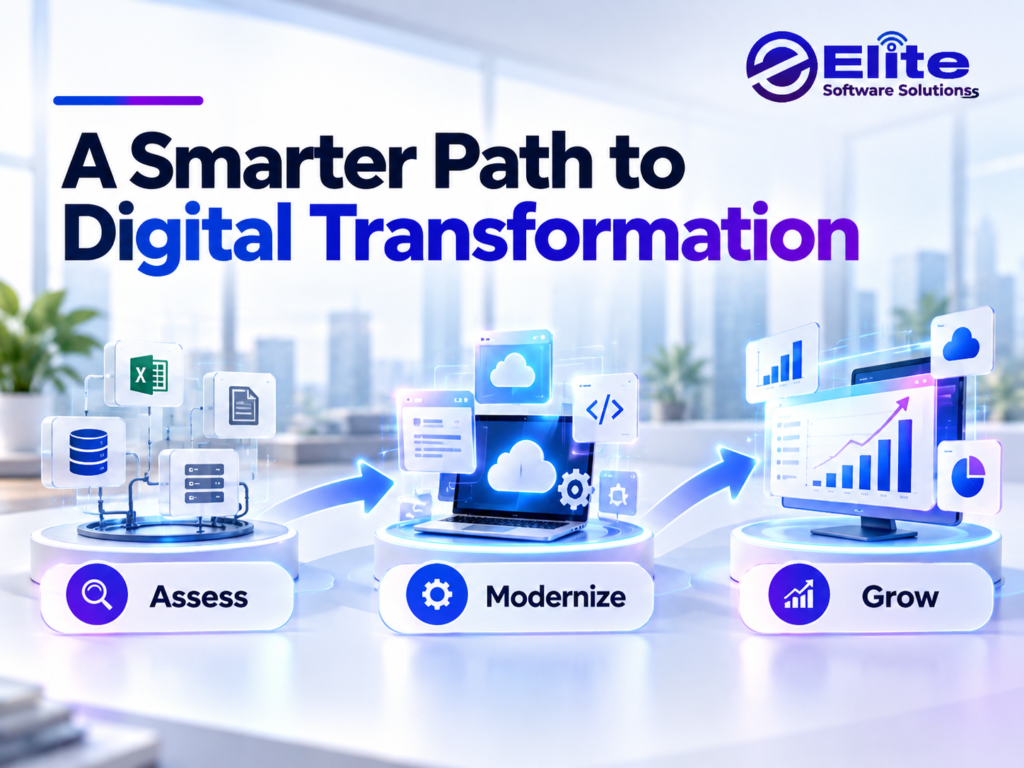
Introduction
Mid-size businesses often reach a stage where the systems and processes that supported their early growth begin to limit their next phase of development. Teams may rely on disconnected software, manual reporting, spreadsheets, and outdated workflows to manage operations. As the business expands, these limitations can make it harder to respond to customer needs, control costs, and make timely decisions.
Digital transformation offers a way to address these challenges by aligning technology, business processes, data, and organizational capabilities with long-term business objectives. However, transformation does not necessarily mean replacing every existing system or investing in the newest technology. The real objective is to identify operational barriers and make targeted improvements that deliver measurable business value.
This is where digital transformation consulting can help. By assessing current capabilities, prioritizing opportunities, and developing a practical implementation roadmap, businesses can make informed technology decisions without overwhelming their teams or resources. This guide explores how mid-size organizations can plan and execute digital transformation in a structured, business-focused way.
What Is Digital Transformation Consulting?
Digital transformation consulting helps businesses evaluate how technology, processes, data, and organizational practices can be improved to support their business goals. Rather than recommending technology in isolation, consultants work with stakeholders to understand existing challenges, identify opportunities, and establish a realistic path toward improvement.
For a mid-size business, this may involve modernizing legacy applications, integrating business systems, automating repetitive processes, improving reporting, strengthening data management, or introducing AI where it addresses a clearly defined need.
The scope depends on the organization’s priorities and current capabilities. A company struggling with inventory visibility may need better system integration, while a service business experiencing delays in customer onboarding may benefit from workflow automation. In both cases, the technology decision should follow an understanding of the business problem.
Effective consulting also considers implementation complexity, employee readiness, budget constraints, information security, and the ability to measure results. These factors help ensure that transformation remains connected to business outcomes rather than becoming a collection of disconnected technology projects.
Why Mid-Size Businesses Need a Digital Transformation Roadmap
Mid-size businesses often operate between two different realities. They need more sophisticated systems and processes as they grow, but they may not have the same technology budgets, specialist teams, or implementation capacity as large enterprises.
Without a clear roadmap, transformation initiatives can become fragmented. One department may adopt a new application while another continues using an incompatible system. Data may be duplicated across platforms, employees may develop workarounds, and management may struggle to determine whether technology investments are delivering value.
A roadmap creates a shared direction. It helps leadership decide which problems require immediate attention, which initiatives depend on other projects, and which investments can wait. It also provides a framework for allocating resources, assigning accountability, managing risk, and communicating progress.
Most importantly, a roadmap allows transformation to happen in manageable stages. Businesses can begin with high-value improvements, learn from implementation, and expand successful approaches instead of attempting a disruptive, organization-wide overhaul from the beginning.
A Practical Digital Transformation Roadmap
Step 1: Define Business Objectives Before Selecting Technology
The first step is to clarify what the business wants to achieve. Objectives may include reducing order-processing delays, improving customer retention, shortening reporting cycles, increasing operational visibility, or supporting expansion into new markets.
These objectives should be specific enough to guide decisions. For example, a company experiencing delays in order fulfillment should investigate where the delays occur, which teams are affected, and what information is missing. Simply deciding to purchase a new enterprise platform before understanding these issues may add cost without solving the underlying problem.
Leadership should identify the business outcomes that matter most and agree on how progress will be evaluated. This establishes a clear foundation for the remaining transformation activities.
Step 2: Assess Existing Systems, Processes, and Data
Once the objectives are clear, the business needs an accurate picture of its current technology environment. This assessment should cover business applications, infrastructure, data quality, integrations, manual workflows, security controls, and existing vendor arrangements.
Process mapping can reveal where employees repeatedly enter the same information, wait for approvals, reconcile inconsistent reports, or move data between systems manually. Discussions with employees are particularly valuable because operational difficulties are not always visible in software documentation or management reports.
The assessment should also identify systems that continue to provide value. Not every legacy application needs immediate replacement. Some systems may be improved through integration, configuration, or process changes, while others may present significant limitations or risks.
The outcome should be a prioritized list of business and technology gaps, supported by evidence rather than assumptions.
Step 3: Prioritize Initiatives Based on Business Value
After identifying opportunities, the organization should evaluate them according to business impact, implementation effort, cost, risk, and dependencies.
For example, automating a repetitive reporting process may deliver benefits relatively quickly if the underlying data is reliable. By contrast, replacing a core business platform may require extensive migration, employee training, integration work, and operational planning.
Mid-size businesses should avoid treating every identified issue as an immediate project. A more effective approach is to select a small number of initiatives that address important business needs and can be implemented with the available resources.
Prioritization should also account for foundational work. Data cleanup, identity management, integration architecture, or process standardization may not produce an immediate visible improvement, but they can be essential to the success of later initiatives.
Step 4: Build an Integrated Technology Strategy
With priorities established, the next step is to determine how the required technology components will work together. This may involve cloud services, enterprise applications, custom software, data platforms, workflow automation, or AI-enabled capabilities.
The objective is not to maximize the number of technologies used. It is to create a reliable environment in which systems exchange information appropriately, employees can access the data they need, and the business can maintain its operations as requirements change.
Integration deserves particular attention. When applications remain disconnected, organizations may continue relying on manual data transfers even after purchasing modern software. A well-designed strategy considers how information flows across departments, how data quality will be maintained, and how access and security will be managed.
Technology selection should also consider scalability, interoperability, maintainability, total cost of ownership, and the organization’s internal capabilities. These considerations help prevent short-term decisions from creating avoidable limitations later.
Step 5: Implement Through Manageable Phases
A phased implementation approach allows businesses to introduce change while controlling operational disruption. The first phase should generally address a clearly defined problem with an achievable scope and measurable outcomes.
For example, a distributor might begin by integrating inventory and order information to improve stock visibility. After validating the results, it could extend the initiative to purchasing forecasts, supplier coordination, or more advanced analytics.
Each phase should have a defined owner, timeline, budget, acceptance criteria, and approach to risk management. Dependencies between projects should be documented so that teams do not build new capabilities on top of unreliable data or incomplete integrations.
Phased delivery also creates opportunities to incorporate feedback. If the first implementation reveals that employees need different workflows or that a system integration requires adjustment, the organization can respond before expanding the solution.
Step 6: Prepare Employees for New Ways of Working
Technology transformation changes how people perform their jobs, make decisions, and collaborate. Even a technically successful implementation can underperform when employees do not understand the purpose of the change or lack the training needed to use new systems.
Organizations should involve affected teams early, explain the operational reasons behind the transformation, and provide role-specific training. Employees should have opportunities to raise concerns and report practical problems during implementation.
Process documentation, internal support, and clearly assigned responsibilities can help new workflows become part of everyday operations. Leadership should also communicate that transformation is an ongoing improvement process rather than a one-time software launch.
Step 7: Measure Results and Improve Continuously
The final step is to evaluate whether the initiatives are achieving their intended outcomes. Measurement should begin before implementation so that the business has a baseline for comparison.
Depending on the project, useful indicators may include processing time, error rates, manual work hours, customer response times, system availability, data accuracy, adoption rates, and cost per transaction.
These metrics should be connected to the original business objectives. If the purpose of a new workflow is to reduce delays, the organization should measure how long the relevant process takes before and after implementation rather than relying only on the number of automated steps.
Regular reviews help leadership determine whether to refine the solution, expand it, or redirect resources to a higher-priority need. This creates a continuous cycle of assessment, implementation, measurement, and improvement.
Common Digital Transformation Opportunities for Mid-Size Businesses
Process Automation
Repetitive tasks such as document routing, approval requests, invoice processing, and routine notifications can consume significant employee time. Workflow automation can reduce unnecessary manual work and make processes more consistent.
Before automating a process, businesses should examine whether the workflow itself needs improvement. Automating an inefficient process without addressing its underlying problems can simply make those problems happen faster.
Data Integration and Business Intelligence
When departments maintain separate systems, management may receive conflicting reports or spend considerable time consolidating information. Data integration and business intelligence tools can help create more consistent reporting and improve visibility across operations.
However, meaningful analytics depends on reliable data definitions, appropriate access controls, and clear ownership. Businesses should address these foundations before relying on dashboards for important operational decisions.
Legacy Application Modernization
Older applications may still support critical business activities but become increasingly difficult to maintain, integrate, or scale. Depending on the situation, modernization may involve updating selected components, improving interfaces, migrating specific workloads, or replacing the application entirely.
The appropriate option depends on business continuity requirements, technical limitations, security risks, and long-term maintenance costs. A careful assessment helps organizations avoid unnecessary replacement projects while addressing genuine constraints.
Artificial Intelligence and Intelligent Automation
AI may support activities such as document classification, information retrieval, customer support assistance, forecasting, and analysis of large volumes of business information. Its suitability depends on the quality of available data, the reliability required, and the consequences of an incorrect result.
Businesses should start with a defined use case, establish appropriate human oversight, evaluate privacy and security risks, and measure performance against an existing process. AI should complement a sound operating model rather than be introduced simply because it is available.
Customer Experience Improvement
Disconnected customer information and manual handoffs can make it difficult to provide consistent service. Better integration between customer relationship management systems, support tools, sales platforms, and operational applications can improve visibility across the customer journey.
The business should identify specific points of friction, such as slow responses, repeated information requests, or inconsistent updates. Technology investments can then be directed toward improvements that customers and employees can meaningfully experience.
Common Digital Transformation Mistakes to Avoid
One frequent mistake is starting with a technology purchase instead of a business objective. A platform may offer extensive capabilities, but those features provide little value if they do not address the organization’s most important operational challenges.
Another mistake is attempting to transform every department simultaneously. Large, overlapping initiatives can stretch budgets, overwhelm employees, and make it difficult to determine which changes are producing results. A phased roadmap offers more control and allows the business to learn from each stage.
Organizations may also underestimate data quality and integration requirements. New applications cannot automatically resolve inconsistent records, duplicated information, or poorly defined processes. These issues should be addressed as part of the transformation plan.
Finally, businesses sometimes measure success by project completion rather than business impact. Delivering software on schedule is important, but it does not prove that productivity has improved or costs have decreased. Results must be assessed against the objectives that justified the investment.
How to Choose the Right Digital Transformation Consulting Partner
The right consulting partner should understand business operations as well as technology. The engagement should begin with questions about the organization’s goals, current challenges, existing systems, internal capabilities, and constraints rather than an immediate recommendation to purchase a particular product.
Look for a structured approach to discovery, prioritization, solution design, implementation planning, risk management, and performance measurement. The partner should be able to explain trade-offs clearly, identify dependencies, and distinguish essential improvements from optional enhancements.
It is also important to clarify responsibilities. Business leaders and internal subject-matter experts need to remain involved in decisions about workflows, policies, and operational priorities. The consulting partner should provide guidance and technical expertise while helping the organization develop a realistic implementation plan.
For additional perspective on planning technology investments around business needs, read “Software Development for Startups: A Complete Guide to Building, Launching, and Scaling Your Product.” Although its primary audience is startups, its focus on defining requirements, making technology decisions, and planning for growth offers a useful connection to the broader challenge of building technology around business objectives.
Conclusion
Digital transformation is most effective when it begins with business priorities and follows a clear, measurable roadmap. For mid-size businesses, the process should start with defining objectives, assessing existing systems, identifying high-value opportunities, and selecting initiatives that fit available resources.
A phased implementation strategy, supported by employee involvement, sound integration planning, appropriate security controls, and continuous measurement, can help organizations modernize without creating unnecessary disruption. The goal is not to adopt every new technology but to build the capabilities needed to operate more efficiently, make better decisions, and respond to changing business demands.
By treating transformation as an ongoing business improvement process, mid-size organizations can make technology investments more purposeful and establish a stronger foundation for sustainable growth.
Frequently Asked Questions
What does digital transformation consulting include?
It typically includes business and technology assessments, process analysis, opportunity prioritization, technology strategy, implementation roadmaps, risk assessment, change management planning, and performance measurement. The exact scope depends on the organization’s needs.
Why is digital transformation important for mid-size businesses?
It can help mid-size businesses reduce manual work, connect disconnected systems, improve operational visibility, modernize aging applications, and support growth. The benefits depend on selecting initiatives that address real business problems.
How long does digital transformation take?
The timeline varies with the scope, complexity, systems involved, available resources, and organizational readiness. Smaller improvements may be delivered in weeks or months, while broader transformation programs can take considerably longer. A phased roadmap helps establish realistic milestones.
Does digital transformation require replacing existing software?
No. Some systems may be improved through integration, configuration, upgrades, or process redesign. Replacement is appropriate when an existing system cannot adequately meet business, security, integration, or scalability requirements.
How should a business measure digital transformation success?
Businesses should define measurable outcomes before implementation. Depending on the initiative, these may include reduced processing time, fewer errors, lower operating costs, better data accuracy, improved customer response times, higher adoption, or greater system reliability.
When should a mid-size business hire a digital transformation consultant?
Consulting support may be useful when leadership lacks a clear modernization roadmap, departments use disconnected systems, technology investments are not delivering expected value, or the business needs specialist guidance to plan a complex transformation.