
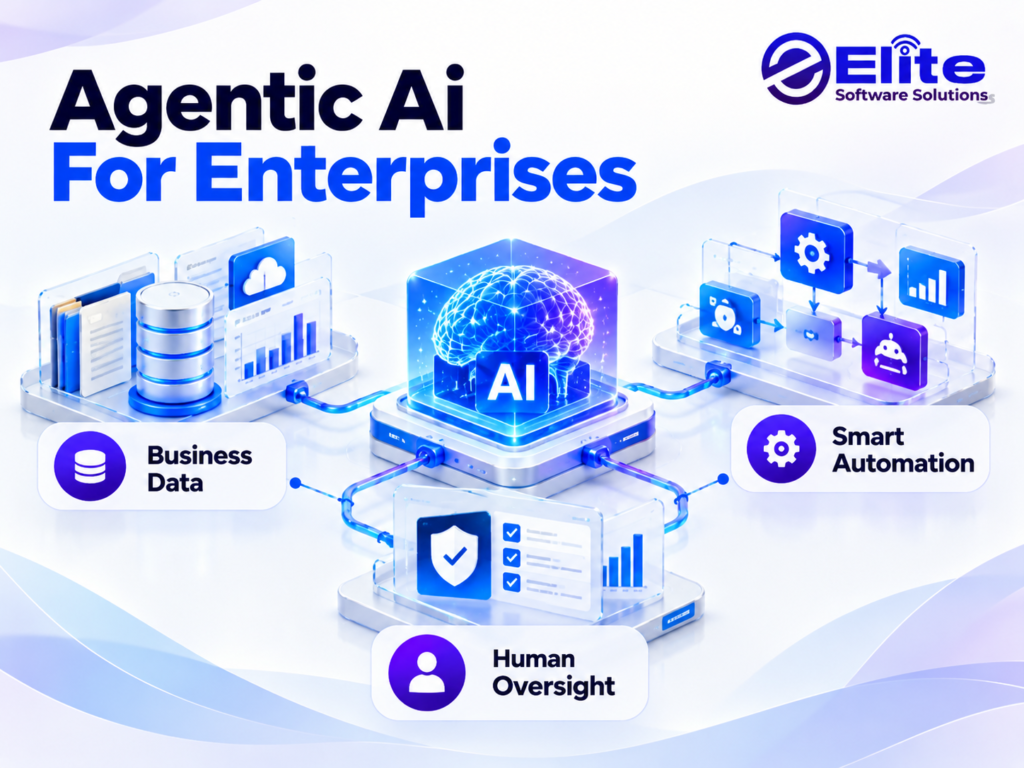
Introduction
Enterprise AI is moving beyond tools that simply answer questions or generate content. Agentic AI systems can interpret goals, plan multi-step tasks, use approved tools, retrieve relevant information, and take actions within defined boundaries. When designed carefully, these systems can help businesses streamline repetitive workflows, improve access to information, and coordinate processes across multiple applications.
However, implementing agentic AI requires more than choosing a model and connecting it to company data. Enterprises must consider business objectives, system integration, access permissions, data quality, security, human oversight, and measurable outcomes. Understanding these requirements helps organizations determine where AI agents can create practical value and how to introduce them responsibly.
What Is Agentic AI Development?
Agentic AI development involves designing and implementing AI-powered systems that can work toward a defined objective by planning tasks, using tools, evaluating results, and deciding what to do next within approved constraints. Depending on the use case, an agent may retrieve information from internal knowledge bases, interact with business applications, prepare recommendations, or execute authorized workflow steps.
Unlike a conventional chatbot that primarily responds to individual prompts, an AI agent may coordinate several steps to complete a task. For example, a customer-support agent could retrieve an order record, review an approved refund policy, draft a response, and route the case for human approval. The specific level of autonomy depends on the system’s permissions, reliability, and risk controls.
Agentic AI does not eliminate the need for business rules or human decision-making. Its effectiveness depends on the quality of the underlying data, the clarity of its assigned objective, and the safeguards governing its actions.
Why Enterprises Are Exploring AI Agents
Many enterprise processes involve repeated information gathering, decisions based on established policies, and coordination between disconnected systems. Employees may need to search multiple applications, update records, prepare reports, or transfer information between departments. These activities can consume time and introduce avoidable inconsistencies.
AI agents can help coordinate selected steps in these workflows. They may retrieve information from approved sources, summarize complex records, recommend next actions, or perform routine updates when authorized. This can allow employees to focus more attention on exceptions, customer relationships, and decisions requiring professional judgment.
The business case should nevertheless be specific. Organizations should identify the process being improved, establish its existing performance, and determine whether an agent can deliver a meaningful improvement without creating unacceptable operational risk.
Common Enterprise Use Cases for Agentic AI
Customer Service and Support
AI agents can assist support teams by retrieving customer information, searching approved knowledge bases, categorizing incoming requests, and preparing responses. With suitable integrations and permission controls, they may also help initiate routine service workflows.
For sensitive cases, complaints, unusual refund requests, or decisions involving contractual obligations, the agent should escalate the issue to an authorized employee rather than act independently. This approach combines automation with human accountability.
Internal Knowledge Management
Large organizations often distribute information across documents, databases, intranets, and business applications. An internal AI agent can help employees locate relevant material, summarize policies, and assemble information from approved sources.
Reliable knowledge retrieval is particularly important in this scenario. The system should distinguish verified company information from uncertain responses and provide source references where feasible so employees can check the information before relying on it.
Sales and Marketing Operations
AI agents can support sales teams by consolidating approved customer information, preparing account summaries, organizing research, and drafting personalized outreach for review. Marketing teams may use them to coordinate content workflows, summarize campaign information, or assist with reporting.
These activities should follow company policies for customer data, consent, brand communication, and approval. Automatically sending messages or modifying customer records without suitable checks can create reputational and compliance risks.
Finance and Administrative Workflows
Finance and operations teams can explore AI agents for document classification, invoice information extraction, reconciliation assistance, exception identification, and report preparation. An agent might gather information from multiple records and flag discrepancies for review.
Financial transactions, payments, approvals, and changes to sensitive records require stronger safeguards than low-risk administrative tasks. Organizations should maintain clear approval thresholds, audit trails, and separation of duties.
IT Operations and Enterprise Support
AI agents may help IT teams classify support tickets, retrieve troubleshooting procedures, summarize system alerts, and recommend remediation steps. In carefully controlled environments, they may also execute predefined diagnostic actions.
Actions that affect production systems, user access, or business-critical infrastructure should be governed by explicit permissions and rollback procedures. Human approval may be necessary before changes that could interrupt services or expose sensitive information.
What Do AI Agent Development Services Include?
Selecting an appropriate development approach begins with the business problem rather than the technology. Professional ai agent development services can support organizations in planning, building, and integrating AI agent solutions around defined workflows and operational requirements.
Business Analysis and Use-Case Discovery
The initial stage identifies processes that may benefit from agent-based automation. Teams examine existing workflows, the systems involved, decision points, exception handling, and the business outcomes that matter.
A useful assessment also determines whether an AI agent is necessary. Some processes may be better served by conventional automation, a rules-based workflow, or a simpler AI assistant. Choosing the least complex solution that meets the requirement can reduce implementation costs and operational uncertainty.
Agent Architecture and Workflow Design
Architecture decisions depend on the complexity and risk of the task. A solution may use one agent with access to a limited set of tools, or multiple specialized agents coordinated through a controlled workflow. Multi-agent architectures can be useful for some complex tasks, but they also introduce additional coordination, testing, and monitoring requirements.
The design should specify the agent’s responsibilities, permitted actions, data sources, decision boundaries, and escalation conditions. These rules make it easier to evaluate the system and determine when human intervention is required.
Model Selection and Knowledge Integration
AI agents may use large language models, retrieval-augmented generation, structured business data, APIs, or a combination of technologies. The appropriate design depends on the task’s accuracy requirements, response time, cost, privacy constraints, and need for current information.
Connecting an agent to company knowledge requires careful attention to access permissions, document quality, and information freshness. The system should only retrieve data the requesting user or process is authorized to access. Sensitive information should not become available merely because it is connected to an AI workflow.
Enterprise System Integration
An AI agent may need to interact with customer relationship management platforms, enterprise resource planning systems, databases, document repositories, ticketing tools, or internal applications. Integrations should use approved APIs and clearly defined permissions wherever possible.
Before enabling actions, organizations should test how the agent handles missing data, duplicate records, API failures, ambiguous instructions, and unexpected responses. Reliable integration is essential because an incorrect action can have a greater business impact than an inaccurate conversational answer.
Testing, Deployment, and Continuous Improvement
Testing should evaluate more than whether the agent produces a convincing response. It should measure task completion, factual accuracy, tool selection, policy compliance, exception handling, latency, cost, and resistance to misleading inputs.
After deployment, monitoring should track real-world performance and identify failure patterns. Organizations may need to update prompts, retrieval sources, model configurations, tool permissions, or workflow rules as business requirements change.
Security, Governance, and Human Oversight
An AI agent may have access to internal information and tools that can affect business operations. This makes security and governance fundamental parts of the implementation rather than optional features added after development.
Enterprises should apply least-privilege access, authenticate tool requests, protect sensitive data, and record important actions. Agents should have access only to the information and functions required for their assigned tasks. Where appropriate, organizations should use approval gates for payments, account changes, external communications, or other consequential actions.
Teams should also consider prompt injection, unauthorized data disclosure, unreliable outputs, excessive tool permissions, and unexpected behavior when external content influences an agent’s decisions. Testing must account for both technical failures and misuse scenarios.
Human oversight should reflect the level of risk. Low-impact actions may be automated after adequate testing, while high-impact decisions may require explicit approval. Organizations should define who is accountable for decisions, how incidents are escalated, and how actions can be reviewed or reversed.
For a more detailed discussion of enterprise safeguards, refer to Agentic AI Security: Risks & Governance for Enterprises. This related article explores security and governance considerations that complement the development and implementation process.
How to Measure the Business Value of AI Agents
The value of an AI agent should be assessed against a defined business baseline. Useful measures may include average task completion time, manual effort per transaction, resolution time, error rates, escalation frequency, service quality, and cost per completed task.
For example, an organization considering an AI agent for internal support could first measure how long employees spend locating information and resolving common requests. After a controlled pilot, the team could compare task completion time, response accuracy, user satisfaction, and the percentage of cases requiring human intervention.
The assessment should include the total cost of operating the solution, including model usage, infrastructure, integration, monitoring, security controls, and ongoing maintenance. Automation that appears efficient in a demonstration may not produce positive business value if it requires extensive correction or generates costly errors.
A Practical Roadmap for Enterprise Implementation
A measured implementation approach helps businesses reduce risk and learn from real usage before expanding deployment. Start by selecting a clearly defined workflow with an identifiable business problem, accessible data, and measurable success criteria.
Next, map the workflow and identify which actions the agent may perform, which require approval, and which must remain under human control. Build a limited proof of concept using representative data and realistic scenarios. Test normal operations as well as edge cases, unauthorized requests, missing information, and integration failures.
Once the solution meets agreed performance and safety criteria, introduce it to a controlled group of users. Monitor results, collect feedback, and refine the system before considering broader deployment. Expansion should depend on demonstrated performance rather than the assumption that an agent successful in one workflow will work equally well in another.
Organizations should also plan for ownership after launch. A responsible team needs to monitor system performance, manage access, maintain integrations, review incidents, and update the solution when business processes change.
Common Challenges Enterprises Should Anticipate
One challenge is unreliable output. AI agents may misunderstand a request, select the wrong tool, or generate an answer that is not supported by available information. Grounding responses in trusted sources, limiting available actions, validating inputs, and testing realistic scenarios can reduce these risks.
Another challenge is fragmented or outdated data. An agent cannot consistently produce reliable results if source systems contain conflicting records or unclear permissions. Data governance and integration quality therefore influence the effectiveness of the overall solution.
Uncontrolled autonomy is also a concern. Giving an agent broad access before it has been thoroughly evaluated can expose systems to unnecessary risk. A staged rollout, narrow permissions, human approval for consequential actions, and clear recovery procedures provide a more controlled path to adoption.
Finally, organizations may underestimate ongoing operational work. AI agents require monitoring, evaluation, updates, and ownership. Sustainable implementation depends on treating them as maintained business systems rather than one-time software projects.
Conclusion
Agentic AI can help enterprises coordinate information-intensive workflows, assist employees with routine decisions, and automate selected operational tasks. However, meaningful results depend on more than model capability. Businesses need a clear use case, reliable data, secure integrations, defined permissions, appropriate human oversight, and measurable performance targets.
The most practical approach is to begin with a bounded workflow, validate the results, and expand only when the evidence supports doing so. With disciplined development and governance, AI agents can become useful components of an enterprise technology strategy while keeping accountability and operational control in place.
Frequently Asked Questions
What are agentic AI development services?
Agentic AI development services help businesses plan, design, build, integrate, test, and maintain AI agents that can carry out defined tasks using approved tools and data. The scope depends on the business requirements and the level of autonomy appropriate for the workflow.
How are AI agents different from chatbots?
A conventional chatbot generally responds to user messages, while an AI agent may plan and execute multiple steps toward a defined objective. Some chatbots also use tools, so the distinction depends on the system’s ability to coordinate actions, manage workflow state, and operate within defined permissions.
Which enterprise processes are suitable for AI agents?
Potential use cases include customer support, internal knowledge retrieval, sales operations, document processing, IT support, and selected administrative workflows. Suitability depends on process clarity, data quality, integration availability, risk, and the ability to measure outcomes.
Are AI agents safe for enterprise use?
AI agents can be deployed with security controls, but no design guarantees zero risk. Organizations should use restricted permissions, data protection, testing, logging, monitoring, escalation rules, and human approval for high-impact actions.
How should a company begin an AI agent project?
Start with a specific business problem and a measurable baseline. Evaluate whether an AI agent is appropriate, define its permitted actions, build a limited pilot, test realistic failure scenarios, and expand only after the system meets agreed requirements.
How can enterprises measure AI agent ROI?
Measure improvements such as reduced processing time, lower manual effort, fewer errors, improved resolution rates, and better service outcomes. Compare those benefits with development, integration, model usage, monitoring, security, and maintenance costs.