
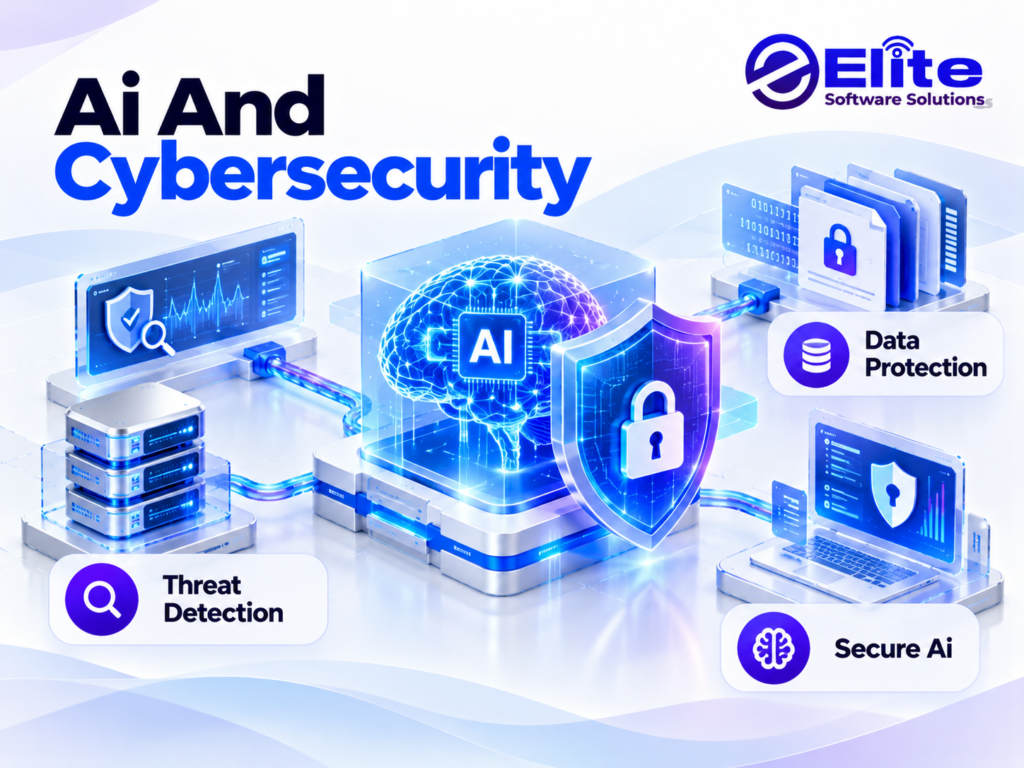
Artificial intelligence is reshaping cybersecurity in 2026. Businesses are using AI to detect suspicious activity, automate security operations, analyze threats, and improve incident response. At the same time, cybercriminals are adopting AI to accelerate phishing campaigns, automate reconnaissance, create convincing impersonations, and exploit weaknesses in enterprise systems.
The growing adoption of AI agents introduces another layer of risk. AI systems can now interact with business applications, retrieve sensitive information, and execute tasks through connected tools. Without appropriate safeguards, these capabilities can expand the attack surface and expose organizations to unauthorized access, data leakage, and operational disruption.
The World Economic Forum’s Global Cybersecurity Outlook 2026 highlights how AI adoption, geopolitical fragmentation, and unequal cybersecurity capabilities are reshaping the global threat landscape. The report reinforces the need for businesses to strengthen their security strategies as technology and attack methods evolve.
For organizations, the priority is not to avoid AI altogether. It is to adopt AI responsibly while strengthening identity protection, data security, threat detection, and operational resilience. Understanding emerging threats and implementing practical controls can help businesses reduce exposure while continuing to benefit from AI-driven innovation.
How AI Is Changing the Cybersecurity Landscape in 2026
AI is changing both how cyberattacks are conducted and how organizations defend themselves. Traditional threats such as phishing, ransomware, credential theft, and software vulnerabilities remain relevant, but AI can make these activities faster, more personalized, and easier to scale.
Attackers can use generative AI to create convincing messages, analyze publicly available information about targets, and adapt social-engineering campaigns to specific industries or individuals. AI can also assist with malicious code development and vulnerability research, although its effectiveness depends on the tools, access, and technical capabilities involved.
Defenders are using AI to analyze security alerts, identify unusual behavior, correlate events across systems, and prioritize vulnerabilities. These capabilities can help security teams investigate incidents more efficiently, particularly when organizations generate more alerts than their analysts can manually review.
The central challenge is that AI does not eliminate the fundamentals of cybersecurity. Weak passwords, excessive permissions, unpatched systems, exposed data, and poorly secured applications remain major sources of risk. Businesses must combine AI-enabled defenses with strong security architecture, disciplined access management, and continuous monitoring.
Emerging AI-Driven Cybersecurity Threats in 2026
AI-Powered Phishing and Social Engineering
Phishing remains an effective way to compromise business accounts because it targets human behavior rather than relying exclusively on technical vulnerabilities. Generative AI allows attackers to produce fluent, personalized messages that imitate business communication and adapt to a target’s role, language, or organization.
Voice cloning, synthetic video, and manipulated audio can also support impersonation attempts involving executives, suppliers, customers, or finance teams. A convincing voice or video call should not be treated as sufficient proof of identity, particularly when the request involves payments, credential sharing, or sensitive information.
Businesses should strengthen phishing-resistant multifactor authentication, use verified communication channels for sensitive requests, and establish independent approval procedures for financial transactions and changes to payment details. Employee training should include realistic AI-assisted impersonation scenarios rather than focusing only on obvious spelling errors or suspicious links.
Automated Reconnaissance and Vulnerability Exploitation
Cybercriminals can use AI-assisted tools to collect public information, organize findings about potential targets, and support vulnerability analysis. Automation can reduce the time required to identify exposed services, misconfigured systems, and potentially vulnerable applications.
The risk becomes more serious when organizations cannot identify their internet-facing assets or remediate critical vulnerabilities promptly. A delay between discovering a weakness and applying a fix can provide attackers with an opportunity to exploit it.
Organizations should maintain an accurate inventory of systems, prioritize vulnerabilities according to exploitability and business impact, and apply security patches within defined timeframes. External exposure management, secure configuration, and regular penetration testing can help identify weaknesses before they are exploited.
AI-Assisted Malware and Ransomware
AI can assist malicious actors with tasks such as generating scripts, adapting code, interpreting technical information, and improving the efficiency of attack preparation. However, AI-generated code does not automatically become sophisticated or successful malware; malicious activity still depends on execution, access, infrastructure, and the effectiveness of defensive controls.
Ransomware remains a serious business risk because it can interrupt operations, expose confidential information, and create significant recovery costs. AI-assisted reconnaissance or social engineering may help attackers prepare for such incidents.
Businesses should implement endpoint detection and response, application controls, network segmentation, least-privilege access, and reliable offline or immutable backups. Recovery procedures should be tested regularly so that an organization can restore critical services even when production systems are compromised.
Deepfakes and Business Identity Fraud
Synthetic audio, images, and video can make fraudulent communications more convincing. Attackers may impersonate senior leaders to request urgent transfers, imitate vendors to redirect payments, or fabricate evidence intended to influence employees and customers.
The risk is particularly high in workflows where urgency, hierarchy, or financial pressure discourages verification.
A strong defense requires process controls rather than relying solely on employees to recognize manipulated media. Organizations should require independent verification for unusual payment requests, enforce dual authorization for high-value transactions, and establish clear escalation procedures for suspicious instructions.
Software Supply Chain and AI Tool Compromise
Modern businesses depend on third-party libraries, cloud services, APIs, development tools, and external AI platforms. A compromise in one of these dependencies can create risks across multiple applications or organizations.
AI development introduces additional dependencies, including model providers, retrieval components, agent frameworks, plugins, and tools connected to enterprise systems. Malicious or compromised components may expose credentials, introduce unsafe behavior, or provide unauthorized access to data.
Organizations should review third-party security practices, maintain software bills of materials where appropriate, scan dependencies, verify package sources, protect development credentials, and restrict the permissions granted to external services. AI-related dependencies should undergo the same security scrutiny as other production software components.
New Risks From AI Agents in Enterprise Environments
AI agents introduce security considerations beyond those associated with conventional chatbots. An agent may retrieve documents, call APIs, update records, or coordinate actions across multiple systems. If its permissions or operating boundaries are poorly designed, a compromised or manipulated agent may affect business resources beyond the original interaction.
Prompt Injection and Instruction Manipulation
Prompt injection occurs when malicious instructions embedded in user input, documents, websites, emails, or other content influence an AI system to behave in unintended ways. An agent that processes untrusted content may be manipulated into revealing information, ignoring intended restrictions, or attempting unauthorized actions.
Traditional input filtering alone cannot guarantee protection because natural-language instructions and trusted business content can be difficult to distinguish reliably.
Organizations should treat external content as untrusted, separate instructions from retrieved information, restrict the actions an agent can perform, and validate sensitive operations independently. High-impact actions should require authorization outside the model’s own reasoning process.
Excessive Permissions and Unauthorized Actions
An AI agent with broad access to enterprise applications can create a substantial security exposure. If it can read confidential files, modify customer records, send external messages, or initiate transactions without sufficient controls, a single failure may have consequences across multiple systems.
Each agent should have a defined purpose and the minimum permissions needed to complete its assigned tasks. Access should be scoped by user, application, data sensitivity, and action type. Organizations should also separate read-only operations from actions that modify records or trigger external consequences.
Human approval should be required where the potential impact justifies it, particularly for financial transactions, changes to access permissions, sensitive data transfers, and other high-risk actions.
Sensitive Data Exposure Through AI Systems
Employees may unintentionally submit customer information, source code, credentials, financial records, or internal documents to unapproved AI services. Enterprise AI applications can also expose information if retrieval permissions, conversation storage, logging, or data-handling policies are incorrectly configured.
Businesses should classify sensitive data, define approved AI services, establish retention rules, and apply data-loss prevention controls where appropriate. Retrieval systems must enforce the same access permissions as the original data sources so that AI does not disclose information to users who would otherwise be unable to access it.
Shadow AI and Unmanaged Agents
Shadow AI refers to AI tools or agents adopted without appropriate organizational approval or oversight. These systems may process sensitive data, connect to business applications, or create operational dependencies without being visible to IT and security teams.
Organizations should maintain an inventory of approved AI applications and agents, establish a process for reviewing new tools, and monitor access to AI services where legally and technically appropriate. Clear usage policies and accessible approved alternatives can help reduce unauthorized adoption.
For a deeper discussion of agent-specific threats, governance, and enterprise safeguards, read Agentic AI Security: Risks & Governance for Enterprises. This related article complements the broader cybersecurity guidance in this guide by focusing on the security implications of agentic AI systems.
Essential Strategies to Protect Businesses From AI-Driven Cyber Threats
Strengthen Identity and Access Management
Identity protection should be a central component of cybersecurity strategy. Attackers frequently exploit compromised credentials, excessive permissions, and weak authentication controls to gain access to business systems.
Organizations should adopt phishing-resistant multifactor authentication where feasible, enforce least-privilege access, use privileged access management, and regularly review user and service accounts. Non-human identities—including API keys, service accounts, and AI agents—must also be managed throughout their lifecycle.
Credentials should be short-lived where practical, securely stored, rotated when necessary, and revoked when no longer required. These measures reduce the opportunity for attackers to reuse stolen credentials or move between systems.
Implement Zero Trust Security
Zero Trust is a security approach that avoids automatically trusting a user, device, application, or workload simply because it is inside a corporate network. Access decisions should consider identity, device status, resource sensitivity, and contextual risk.
For AI-enabled environments, Zero Trust principles should extend to agents and their connected tools. Each request should be authorized according to the resource and action involved rather than relying on broad, inherited permissions.
Network segmentation, continuous access evaluation, strong device controls, and restricted service-to-service communication can limit the impact of a compromised account or application.
Deploy AI-Enabled Threat Detection and Response
AI-assisted security tools can help analyze large volumes of endpoint, identity, network, email, and cloud telemetry. They can identify suspicious patterns, summarize related alerts, and help analysts investigate potential incidents.
Organizations should integrate these tools into established security operations processes rather than treating AI output as automatically correct. Detection rules, threat intelligence, analyst review, and tested response procedures remain essential.
Automated responses should be limited according to risk. For example, a system may automatically enrich an alert or isolate a clearly compromised test endpoint, while disabling a critical production account or modifying a major business system may require human authorization.
Secure AI Applications Throughout Development
AI applications should follow a secure development lifecycle that includes threat modeling, dependency reviews, access-control testing, security testing, and deployment approval.
Teams should evaluate risks specific to AI systems, including prompt injection, unsafe tool invocation, sensitive data leakage, output manipulation, and model or data supply chain compromise. Testing should include realistic adversarial scenarios and assess the entire application—not only the model’s responses.
Organizations developing custom AI applications can explore AI agent development solutions to understand how AI agents can be developed and integrated into business workflows. Security requirements, access boundaries, and governance controls should be considered from the initial design stage rather than added after deployment.
Improve Data Protection and Backup Resilience
Data protection requires controls across storage, transmission, processing, and access. Encryption, data classification, access restrictions, secure key management, and appropriate retention policies help reduce the impact of unauthorized access.
Organizations should also maintain backups that attackers cannot easily modify or delete using compromised production credentials. Backup restoration should be tested against realistic incident scenarios, including ransomware and cloud account compromise.
A documented recovery plan should define recovery priorities, responsibilities, communication procedures, and acceptable recovery objectives for critical business services.
Establish an AI Governance Framework
AI governance defines who can approve AI systems, which data they may use, what actions they may perform, and how their behavior will be monitored. It should cover both AI used for cybersecurity and AI applications that create new security risks.
An effective framework includes an inventory of AI systems, risk classification, ownership, access controls, evaluation requirements, incident reporting, and a process for reviewing material changes.
The NIST AI Risk Management Framework provides guidance for managing AI-related risks across the lifecycle. Organizations can use it alongside established cybersecurity frameworks to create a consistent approach to risk assessment, accountability, and continuous improvement.
Building an AI Cybersecurity Roadmap for 2026
A practical roadmap should begin with the organization’s most significant exposures and business priorities rather than adopting every new security tool at once.
Phase 1: Assess Current Risks
Inventory business-critical systems, sensitive data, cloud assets, AI applications, agents, and third-party dependencies. Identify where credentials, permissions, exposed services, or unmanaged AI tools could create unacceptable risk.
The assessment should also examine incident history, backup readiness, existing security controls, and the organization’s ability to detect and respond to attacks.
Phase 2: Prioritize Foundational Controls
Address high-impact weaknesses first. These commonly include weak authentication, excessive privileges, unpatched internet-facing systems, insufficient endpoint coverage, inadequate backup protection, and missing visibility into sensitive data.
Establish accountable owners, remediation deadlines, and measurable completion criteria. This creates a foundation for safely expanding AI adoption.
Phase 3: Secure AI Systems and Agents
Document the purpose, data access, permissions, integrations, and potential impact of each AI application or agent. Test for prompt injection, data leakage, unauthorized tool use, and unsafe behavior. Require additional review for systems that can modify records, communicate externally, or affect critical operations.
New deployments should have defined acceptance criteria, monitoring, rollback procedures, and incident response plans before production release.
Phase 4: Automate Detection and Response Carefully
Introduce AI-assisted security operations where they can improve investigation speed, alert prioritization, and response consistency. Begin with well-defined workflows and limited permissions, then expand automation after measuring accuracy and operational impact.
Monitor false positives, missed detections, response times, and unintended actions. Keep human oversight for decisions where errors could cause significant business harm.
Phase 5: Test and Improve Continuously
Cybersecurity is an ongoing process rather than a one-time implementation. Conduct regular vulnerability assessments, penetration tests, phishing simulations, access reviews, backup restoration exercises, and incident response drills.
Review the roadmap as business systems, AI capabilities, regulatory obligations, and threat intelligence change. Lessons from incidents and exercises should inform future investments and policy updates.
Measuring the Effectiveness of AI Cybersecurity
Cybersecurity performance should be measured using indicators tied to risk reduction and business resilience. The number of tools deployed or alerts processed does not, by itself, demonstrate that an organization is safer.
Useful measures include mean time to detect and respond to incidents, time to remediate critical vulnerabilities, percentage of privileged accounts protected by strong authentication, coverage of critical assets, frequency of successful recovery tests, and the number of unmanaged AI systems identified and brought under governance.
For AI-enabled defenses, organizations can also measure investigation accuracy, false-positive rates, analyst workload, and the percentage of automated actions completed safely. AI agents should be evaluated for policy violations, unauthorized access attempts, and the reliability of their tool usage.
Leadership should review these indicators alongside business impact, including downtime, recovery costs, exposure of sensitive information, and disruption to critical services. The goal is to improve the organization’s ability to prevent incidents, contain damage, and recover effectively.
Conclusion
AI and cybersecurity are increasingly interconnected in 2026. AI can strengthen threat detection and response, but it can also help attackers scale phishing, reconnaissance, impersonation, and other malicious activities. Meanwhile, AI agents create additional risks when they are connected to sensitive data and business systems without sufficient oversight.
Businesses should respond with a balanced strategy: strengthen identity security, limit privileges, protect sensitive data, secure software dependencies, monitor AI systems, and test recovery capabilities. Governance and human accountability must remain central as AI becomes more deeply integrated into business operations.
The most effective cybersecurity approach combines established security fundamentals with carefully evaluated AI-enabled defenses. Organizations that treat AI security as an ongoing business responsibility—not simply a technology project—will be better prepared to manage emerging threats, protect critical assets, and adopt AI with greater confidence.
Frequently Asked Questions
How is AI changing cybersecurity in 2026?
AI is helping attackers create more convincing social-engineering campaigns, automate reconnaissance, and accelerate parts of cyberattack preparation. Defenders are using AI to analyze security telemetry, prioritize alerts, and support incident response. AI systems and agents are also becoming targets in their own right.
What are the biggest AI-related cybersecurity risks for businesses?
Key risks include AI-assisted phishing, deepfake impersonation, automated vulnerability exploitation, data leakage, prompt injection, excessive AI-agent permissions, compromised software dependencies, and unmanaged AI tools. The most significant risks depend on an organization’s systems, data, industry, and threat exposure.
How can businesses protect AI agents from cyberattacks?
Businesses should restrict agent permissions, enforce strong identity controls, treat external content as untrusted, validate tool actions, protect sensitive data, and monitor agent activity. High-impact actions should require appropriate authorization, and AI systems should be tested against realistic adversarial scenarios before deployment.
Can AI replace a traditional cybersecurity team?
No. AI can help automate repetitive tasks, prioritize alerts, and support investigation, but it cannot eliminate the need for security expertise, governance, accountability, and incident response planning. Human oversight remains important for complex investigations and high-impact decisions.
What should businesses prioritize first in 2026?
Start with foundational security: strong authentication, least-privilege access, patch management, endpoint protection, secure backups, and visibility into critical assets. Next, identify AI applications and agents, assess their permissions and data access, and introduce appropriate governance and monitoring.
What is an AI cybersecurity governance framework?
It is a set of policies, responsibilities, technical controls, and review processes that guide how AI systems are selected, developed, deployed, monitored, and retired. It helps organizations manage risks, protect data, establish accountability, and verify that AI systems operate within approved boundaries.