
Introduction
Healthcare is becoming increasingly data-driven, with electronic health records, medical imaging, wearable devices, connected medical equipment, laboratory systems, and other digital technologies generating large volumes of information. The challenge is no longer simply collecting healthcare data, but using it to understand complex biological and operational systems and support better-informed decisions.
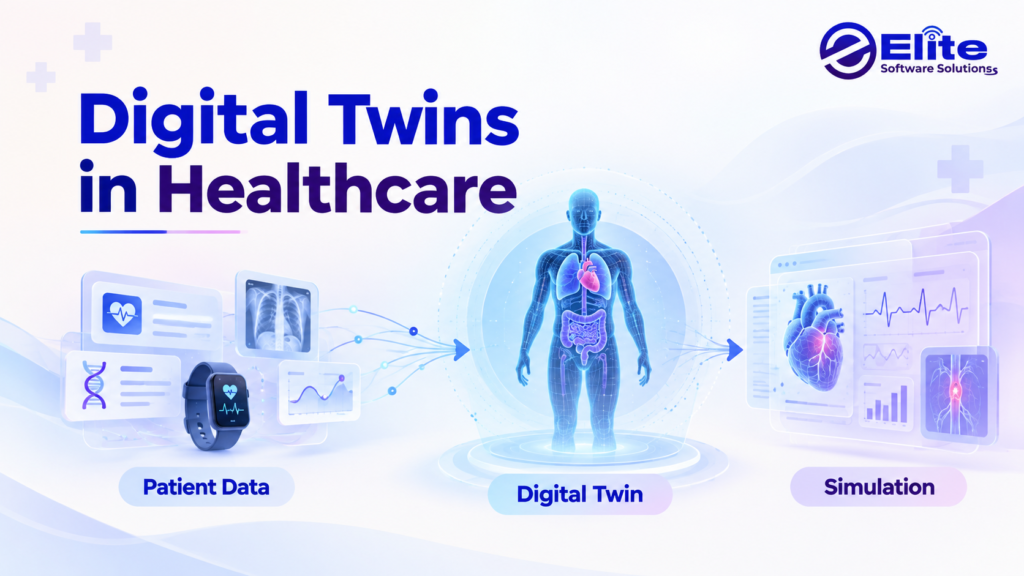
Digital twins in healthcare represent one emerging approach to this challenge. A digital twin is a dynamic digital representation of a physical object, system, or process that is updated using data from its physical counterpart. In healthcare, the concept can be applied to patients, organs, medical devices, treatment pathways, hospital operations, and other healthcare processes.
The U.S. Food and Drug Administration describes a digital twin as an information construct that mimics the structure, context, and behavior of a physical asset, is dynamically updated with data from its physical twin, and informs decisions. The FDA also identifies potential applications in personalized medicine, clinical research, and pharmaceutical manufacturing.
Recent research shows that healthcare digital twins are being investigated across diagnostics, treatment optimization, physiological monitoring, hospital operations, medical research, and personalized medicine. However, much of the current evidence remains at the simulation, prototype, or early-validation stage, making clinical validation, interoperability, privacy, and infrastructure important considerations for adoption.
What Is a Digital Twin in Healthcare?
A healthcare digital twin is a computational representation of a real-world healthcare subject or system that can be updated with relevant data and used for analysis, simulation, prediction, or optimization.
The physical entity could be:
- An individual patient
- An organ or physiological system
- A medical device
- A treatment process
- A hospital department
- A healthcare facility
- A pharmaceutical manufacturing process
The digital representation can combine information from multiple sources, depending on the use case. These may include clinical records, medical imaging, physiological measurements, wearable devices, laboratory results, device data, and other relevant datasets.
The objective is not simply to create a digital copy. A useful digital twin should provide a computational environment in which different scenarios can be analyzed and potentially used to support decisions.
How Digital Twins Work in Healthcare
A healthcare digital twin generally depends on several interconnected technology layers.
Data Collection
The first layer involves collecting relevant information from sources such as electronic health records, medical devices, imaging systems, laboratory systems, sensors, and wearable technologies.
The quality of the resulting digital twin depends heavily on the quality, completeness, timeliness, and relevance of this information.
Data Integration
Healthcare data is frequently distributed across different systems and formats. A digital twin therefore needs mechanisms for integrating relevant information into a coherent representation.
Interoperability is particularly important because fragmented healthcare systems can make it difficult to exchange and synchronize data.
Digital Modeling
The collected information is used to create a computational representation of the physical entity or process.
Depending on the application, this may involve physiological models, statistical models, machine learning, simulation, or combinations of these approaches.
Continuous Updating
A digital twin can be updated as new information becomes available. For a patient-focused application, this could involve incorporating new physiological measurements, laboratory results, imaging information, or other relevant observations.
The frequency and type of updates depend on the intended use.
Simulation and Analysis
Once the digital representation has been established, it can be used to evaluate scenarios.
For example, researchers may investigate how a physiological system could respond to different conditions, while healthcare organizations could model operational processes.
Digital Twins vs Digital Models
The terms digital model, digital shadow, virtual model, and digital twin are sometimes used interchangeably, but they do not necessarily describe the same level of capability.
A basic digital model may represent a physical system without continuously receiving data from it. A digital shadow can involve one-way data flow from a physical system to its digital representation. A more complete digital twin involves dynamic interaction between the physical and virtual environments, with the digital representation being updated by real-world data and supporting decisions. A 2025 scoping review of human digital twins found that only 18 of 149 included studies, or approximately 12.08%, fully met the National Academies’ definition of a human digital twin. The finding illustrates why the term should be used carefully when describing healthcare technologies.
Key Applications of Digital Twins in Healthcare
Research into healthcare digital twins covers several major application areas.
Personalized Medicine
One of the most discussed applications is personalized healthcare.
Instead of relying exclusively on population-level information, a digital representation can incorporate patient-specific data to support analysis of an individual’s characteristics and potential responses.
Potential applications include treatment simulation, disease progression modeling, risk assessment, and personalized treatment planning.
However, digital twins should currently be viewed as decision-support technologies rather than automatic replacements for clinical judgment. Current research continues to identify limitations in validation and real-world clinical integration.
Patient Monitoring
Digital twins can potentially support continuous monitoring by integrating information from wearable devices, sensors, medical equipment, and other data sources.
For example, a system could maintain a dynamic representation of selected physiological characteristics and identify changes that warrant further investigation.
This approach could support earlier detection and more continuous observation, although the quality of the result depends on sensor reliability, data availability, model accuracy, and appropriate clinical validation.
Treatment Planning
Digital twins can potentially be used to simulate how different interventions might affect a patient or physiological system.
Research has investigated patient-specific models in areas including cardiology, oncology, endocrinology, neurology, and other medical fields.
The value of these systems is that simulation may allow clinicians and researchers to investigate scenarios before applying an intervention in the physical world.
Medical Imaging and Diagnostics
Digital twin technologies can combine imaging and physiological information to create more detailed computational representations.
Potential applications include:
- Diagnostic support
- Disease progression modeling
- Imaging analysis
- Risk assessment
- Patient-specific simulation
Current research indicates that digital twins are generally being investigated as tools that augment established diagnostic processes rather than replace them.
Hospital Operations
Digital twins are not limited to individual patients.
Healthcare organizations can also use digital-twin concepts to model operational systems such as hospital workflows, resource allocation, patient movement, equipment utilization, and capacity planning.
A healthcare facility could potentially simulate changes to operational processes before implementing them in the physical environment.
Research reviews identify operational efficiency and hospital management among important healthcare digital-twin application categories.
Medical Device Development
Digital twins can also support the design, testing, monitoring, and optimization of medical devices.
A computational representation of a device can allow engineers and researchers to evaluate selected conditions without relying exclusively on physical prototypes.
This can potentially reduce certain development cycles and provide additional information for device performance analysis, although regulatory and validation requirements remain important.
Drug Discovery and Pharmaceutical Manufacturing
Digital twins can also be applied beyond direct patient care.
The FDA identifies potential digital-twin applications in pharmaceutical manufacturing, while healthcare research has explored applications in drug discovery and biomanufacturing.
Digital representations can potentially help researchers analyze manufacturing conditions, process parameters, and other variables in controlled computational environments.
Benefits of Digital Twins in Healthcare
More Personalized Analysis
Digital twins can incorporate patient-specific information rather than relying entirely on generalized population models.
This creates opportunities for more individualized analysis and treatment simulation.
Predictive Insights
By combining historical and current data with computational models, digital twins may help identify potential patterns and simulate future scenarios.
This can be useful for disease progression modeling, patient monitoring, and operational planning.
Scenario Simulation
One of the central advantages of digital twins is the ability to test scenarios computationally.
Healthcare organizations and researchers can potentially investigate the consequences of different decisions before implementing them in the physical environment.
Operational Optimization
At the organizational level, digital twins can help model healthcare workflows and resources.
Potential applications include capacity planning, equipment utilization, patient flow, and process optimization.
Support for Research
Digital twins can provide computational environments for testing hypotheses, modeling physiological processes, and exploring potential interventions.
This can complement physical experiments and clinical research.
The Role of AI in Healthcare Digital Twins
Artificial intelligence and machine learning can strengthen digital-twin systems by helping analyze complex datasets, identify patterns, generate predictions, and update models.
Recent systematic research shows that healthcare digital-twin studies frequently combine digital twins with AI, machine learning, Internet of Things technologies, and simulation.
The relationship can therefore be viewed as:
Healthcare Data → AI/ML → Digital Model → Simulation → Analysis → Decision Support
However, AI does not automatically make a digital twin accurate. Model quality depends on data quality, validation methodology, representativeness, infrastructure, and the appropriateness of the underlying modeling approach.
For organizations exploring intelligent healthcare systems, Healthcare Agentic AI: Opportunities, Challenges, and Future Directions can provide a related perspective on how AI-based systems are evolving within healthcare environments.
Digital Twins and Healthcare Software Development
A healthcare digital twin requires more than a standalone algorithm. It can involve data integration, application development, APIs, databases, cloud infrastructure, analytics, security, user interfaces, and potentially IoT connectivity.
This makes the software architecture an important part of the implementation.
Healthcare organizations developing digital-twin applications may need software capable of connecting information from multiple sources while presenting complex analytical results in a usable form.
A suitable healthcare software development services approach can support the application layer required to connect healthcare workflows, data systems, analytics, and user-facing interfaces.
The exact architecture depends on the intended application, data requirements, regulatory environment, and integration landscape.
Data Requirements for Healthcare Digital Twins
Data is one of the most important components of a digital-twin system.
Potential data sources include:
- Electronic health records
- Medical imaging
- Laboratory results
- Wearable devices
- IoT sensors
- Medical devices
- Physiological measurements
- Patient-reported information
- Operational healthcare data
However, more data does not automatically produce a better digital twin.
Data must be relevant, sufficiently accurate, appropriately structured, securely handled, and representative of the population and use case.
A 2025 meta-review identified data quality, interoperability, scalability, and clinical validation among the important barriers to healthcare digital-twin adoption.
Challenges of Digital Twins in Healthcare
Data Privacy and Security
Healthcare information is highly sensitive. Digital-twin systems may combine information from multiple sources, increasing the importance of access control, encryption, identity management, auditability, and secure data handling.
Data Quality
Incorrect, incomplete, outdated, or inconsistent data can affect the reliability of a digital twin.
Healthcare organizations therefore need data-quality processes alongside the technical implementation.
Interoperability
Healthcare environments commonly involve multiple systems and vendors.
A digital twin may need to exchange information across electronic records, imaging systems, devices, databases, APIs, and other platforms.
Interoperability can therefore become a significant technical challenge.
Clinical Validation
A digital twin that performs well in a simulation does not automatically demonstrate clinical effectiveness.
Recent systematic research found that real-world clinical integration remains limited and that many studies are still based on simulation, retrospective datasets, or early prototypes.
Computational Requirements
Complex digital twins can require significant computing resources, particularly when processing large datasets or running sophisticated simulations.
Organizations need to consider infrastructure, latency, scalability, and cost.
Bias and Representativeness
A digital twin trained or calibrated using limited or unrepresentative data may not perform equally across different populations.
Researchers have identified demographic diversity and potential bias as important considerations for healthcare digital-twin development.
Regulatory and Ethical Considerations
When digital twins influence clinical decisions or interact with medical technologies, regulatory and ethical requirements become especially important.
The applicable requirements depend on the specific technology, intended use, jurisdiction, and whether the system falls within relevant medical-device or healthcare regulations.
Digital Twins and Clinical Decision Support
Digital twins can potentially support clinicians by providing additional computational analysis rather than replacing professional judgment.
For example, a system could present simulations or predicted scenarios based on patient-specific information.
The clinician can then consider those outputs alongside medical history, examination findings, established clinical guidelines, and other relevant information.
This distinction is important because healthcare decisions involve uncertainty, context, and professional responsibility that cannot necessarily be represented completely within a computational model.
Future Directions for Digital Twins in Healthcare
Research in healthcare digital twins is expanding rapidly, but the field is still developing.
A 2026 systematic review of 26 primary studies found that applications span diagnostics, therapy optimization, physiological monitoring, and system-level modeling. It also identified privacy-preserving approaches, validation pipelines, and interoperability as important enablers for future implementation.
Future development is likely to involve greater integration of:
- Artificial intelligence
- Machine learning
- Internet of Things
- Wearable devices
- Medical imaging
- Real-time data
- Cloud computing
- Predictive analytics
- Simulation
- Privacy-preserving technologies
The broader direction is toward digital systems that can continuously incorporate information, model complex healthcare conditions, and provide decision-support capabilities.
However, technological capability alone will not determine adoption. Clinical evidence, interoperability, governance, security, infrastructure, affordability, and usability will remain critical.
How Healthcare Organizations Can Prepare
Organizations considering digital twins should begin with a clearly defined healthcare or operational problem rather than starting with the technology itself.
A practical approach can include:
Define the Use Case
Determine whether the objective is patient monitoring, treatment planning, operational optimization, research, medical-device development, or another application.
Assess Data Availability
Identify which datasets are available, how reliable they are, and how they can be securely integrated.
Establish the Technical Architecture
Determine the required applications, databases, APIs, analytics, cloud infrastructure, IoT connections, and security controls.
Plan Validation
Define how the digital twin will be evaluated before relying on its outputs in important workflows.
Address Governance
Establish appropriate privacy, security, access, monitoring, and accountability processes.
Measure Outcomes
Define measurable indicators that demonstrate whether the technology is producing the intended operational, research, or clinical value.
Conclusion
Digital twins in healthcare represent an emerging approach to modeling patients, physiological systems, medical devices, treatment processes, and healthcare operations using continuously updated digital representations.
Their potential applications include personalized medicine, treatment simulation, patient monitoring, diagnostics, hospital operations, medical-device development, research, and pharmaceutical manufacturing. Current research demonstrates significant technical progress, but many applications remain in early development, simulation, or validation stages.
The development of effective healthcare digital twins depends on more than advanced algorithms. Reliable data, interoperability, secure software architecture, computational infrastructure, clinical validation, privacy, and appropriate governance are equally important.
As healthcare organizations continue adopting digital technologies, digital twins could become an important component of predictive and personalized healthcare systems. Their long-term impact, however, will depend on how successfully research concepts are translated into validated, secure, interoperable, and clinically useful solutions.
Frequently Asked Questions
What is a digital twin in healthcare?
A healthcare digital twin is a dynamic digital representation of a patient, physiological system, medical device, healthcare process, or other physical entity that can use real-world data for modeling, simulation, analysis, or decision support.
How are digital twins used in healthcare?
Potential applications include personalized medicine, treatment planning, patient monitoring, diagnostics, hospital operations, medical-device development, clinical research, and pharmaceutical manufacturing.
Can a digital twin replace a doctor?
A digital twin is generally intended to provide modeling, simulation, prediction, or decision-support capabilities. It should not automatically be treated as a replacement for clinical judgment, particularly when the technology has not been sufficiently validated for a specific clinical use.
What technologies are used to build healthcare digital twins?
Healthcare digital twins can combine technologies such as artificial intelligence, machine learning, IoT sensors, medical imaging, databases, APIs, cloud computing, simulation, analytics, and healthcare software applications.
What are the biggest challenges of healthcare digital twins?
Major challenges include data quality, privacy, cybersecurity, interoperability, computational requirements, clinical validation, scalability, bias, regulatory considerations, and integration with existing healthcare workflows.
Are healthcare digital twins already widely used?
Research and development are expanding, but current evidence indicates that many healthcare digital-twin applications remain in simulation, prototype, or early-validation stages. Real-world clinical integration is still limited in the published literature.
How can digital twins support personalized medicine?
A digital twin can combine patient-specific information with computational models to simulate or analyze possible conditions and treatment scenarios. The objective is to provide more individualized information for healthcare decision-making.
Why is software development important for digital twins?
Digital twins require applications capable of integrating data, connecting systems, running or presenting analytical models, managing users, and supporting healthcare workflows. Software architecture is therefore a core part of a practical digital-twin implementation.