Introduction
Artificial intelligence is moving from experimentation into real business operations. Companies are using AI for customer service, workflow automation, document processing, predictive analytics, knowledge management, software development, and increasingly autonomous AI agents. As these use cases become more complex, choosing the right development partner becomes just as important as choosing the underlying AI technology.
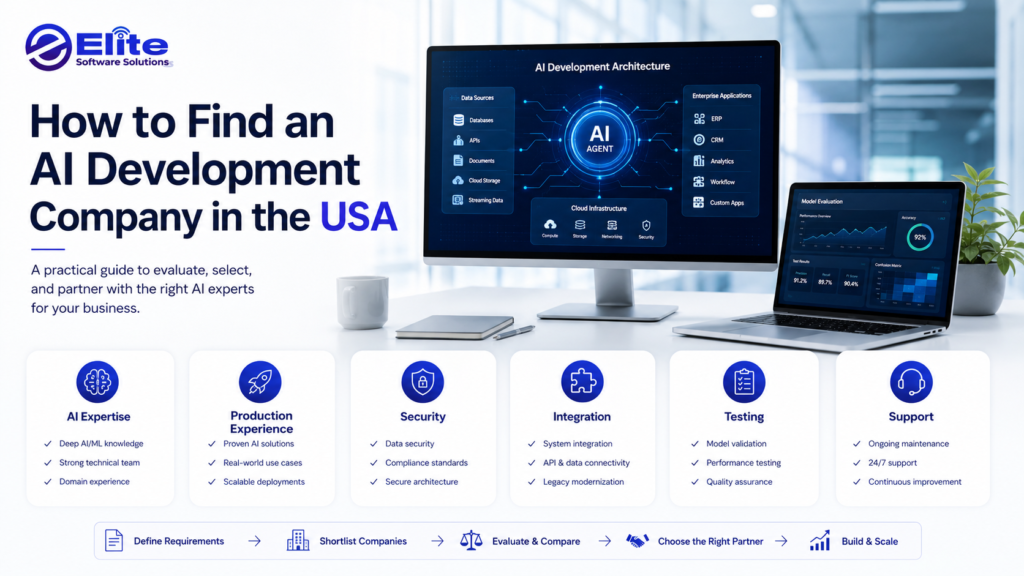
Finding an AI development company in the USA is not simply a matter of searching for vendors that mention artificial intelligence on their websites. A company may have experience connecting an application to an AI API, while another may have the engineering capabilities required to build, integrate, test, secure, deploy, and maintain a production AI system. Current industry guidance increasingly emphasizes production evidence, integrations, security, evaluation, governance, and post-launch ownership when comparing AI development partners.
For businesses evaluating an AI agent development company, the selection process should therefore begin with the business problem and technical requirements rather than with a vendor’s marketing claims.
What Does an AI Development Company Do?
An AI development company helps businesses design, develop, integrate, test, deploy, and maintain software systems that use artificial intelligence. Depending on the project, this can include generative AI applications, machine learning systems, recommendation engines, computer vision solutions, natural-language processing, intelligent automation, enterprise AI assistants, and AI agents.
The scope of work can extend well beyond selecting an AI model. A production system may need data pipelines, application interfaces, databases, authentication, cloud infrastructure, monitoring, security controls, evaluation frameworks, human approval mechanisms, and integration with existing enterprise software.
This is why businesses should evaluate an AI development partner as a technology engineering partner rather than simply as an AI API implementation provider.
Why Choosing the Right AI Development Company Matters
AI projects have technical and operational requirements that are different from conventional software projects. An AI system can produce incorrect results even when the underlying application is functioning correctly. Its performance can also vary according to the quality of the data, prompts, models, retrieval mechanisms, tools, and workflows involved.
For agentic AI systems, the challenge can become greater because an agent may interact with external systems or execute multiple steps. Businesses therefore need to understand what the AI is permitted to do, how its outputs are evaluated, when human approval is required, and how activities are monitored.
The NIST AI Risk Management Framework provides organizations with a structured approach for incorporating trustworthiness considerations into the design, development, deployment, and use of AI systems. Its framework is organized around functions including Govern, Map, Measure, and Manage.
A capable development partner should be able to discuss these considerations rather than focusing only on model capabilities.
How to Find an AI Development Company in the USA
1. Start With Your Business Problem
Before searching for an AI development company, define what you actually want AI to accomplish.
For example, a company might want to automate customer-support requests, extract information from documents, create an internal knowledge assistant, analyze large volumes of business data, automate repetitive workflows, or build an AI agent that can interact with internal applications.
The clearer the business problem, the easier it becomes to determine whether a vendor has relevant experience.
Instead of asking, “Does this company build AI?” ask questions such as:
What business process will the AI improve?
What data will it need?
Which systems will it need to access?
What decisions can it make?
Which actions require human approval?
How will success be measured?
These questions move the discussion from AI as a technology trend to AI as a measurable business solution.
2. Look for Relevant AI Project Experience
A company’s portfolio is one of the first areas to evaluate, but the quality of the portfolio matters more than the number of projects listed.
Look for evidence of projects that resemble your requirements in terms of industry, data complexity, integrations, AI functionality, or scale. A vendor that has built a customer-facing chatbot may not automatically have the expertise required to build an AI agent connected to enterprise systems.
Ask potential vendors to explain the architecture behind relevant projects. A credible development partner should be able to discuss the problem, technical approach, integrations, evaluation process, deployment environment, and lessons learned without relying entirely on marketing language.
Current AI vendor-selection guidance similarly recommends looking for production systems rather than evaluating vendors solely through controlled demonstrations.
3. Evaluate AI Engineering Capabilities
AI development involves multiple technical layers. Depending on the project, the development company may need expertise in large language models, machine learning, retrieval-augmented generation, vector databases, APIs, cloud platforms, data engineering, software architecture, security, monitoring, and AI evaluation.
For AI agents, additional capabilities may be required for tool calling, workflow orchestration, memory, permissions, human-in-the-loop controls, and failure handling. If your project requires an ai agent development company, evaluate whether the provider can design agents around your specific workflows, integrate them with existing systems, implement appropriate guardrails, and support production deployment. Elite Software Solutionss, for example, describes its AI agent services around custom workflows, tool integration, multi-agent collaboration, testing, monitoring, and production deployment.
A strong vendor should be able to explain why a particular architecture is appropriate for your use case rather than simply recommending the latest AI model.
4. Check Their Experience With AI Agents
AI agents differ from conventional chatbots because they can be designed to perform multi-step tasks using tools, data, applications, and defined workflows.
If your project requires an AI agent, ask the development company how it handles:
- Tool and API access
- Data retrieval
- Multi-step planning
- Authentication and permissions
- Human approval
- Error handling
- Agent monitoring
- Logging and observability
- Evaluation and performance measurement
- Model and provider changes
The objective is not to find a company that can demonstrate an impressive agent in a controlled environment. The objective is to find a partner capable of building an agent that can operate reliably within your actual business environment.
5. Examine Integration Capabilities
Enterprise AI rarely operates in isolation.
An AI system may need to connect with CRM platforms, ERP systems, databases, cloud services, internal knowledge bases, communication platforms, payment systems, or custom applications.
Integration experience is therefore an important selection criterion. A vendor should be able to explain how information moves between systems, how authentication is handled, how permissions are enforced, and how failures are managed.
This becomes especially important for AI agents because an agent may need access to multiple tools to complete a workflow.
6. Ask How the Company Handles AI Testing and Evaluation
Traditional software testing and AI evaluation are related but not identical.
A conventional application can often be tested against predefined expected outputs. AI systems may produce different responses to similar inputs, making evaluation more complex. Organizations may need to assess accuracy, relevance, hallucination rates, latency, safety, consistency, tool-use behavior, and task completion.
A development partner should therefore have a clear approach to evaluation before the system reaches production. This should include functional validation, integration testing, regression testing, performance evaluation, security checks, and realistic user-acceptance scenarios.
This is also where software testing capabilities become important. AI applications need conventional application testing alongside appropriate evaluation of model outputs, integrations, workflows, security, and edge cases. Elite Software Solutionss provides functional, performance, automated, security, and regression testing as part of its testing services.
Businesses should ask vendors to explain how they will test the system with representative data and realistic scenarios rather than relying only on a successful demonstration.
7. Review Security and Data-Handling Practices
AI applications can process sensitive business information, including customer records, financial data, internal documents, intellectual property, and employee information.
Before selecting a vendor, ask how data will be stored, transmitted, processed, logged, and retained. Also determine whether information is shared with third-party model providers and what controls exist around access.
Depending on the industry and use case, businesses may also need to consider regulatory and contractual requirements.
NIST’s AI Risk Management Framework is designed to help organizations manage AI-related risks and incorporate trustworthiness into AI design, development, deployment, and use.
A credible vendor should be able to provide clear answers about security architecture and data handling instead of simply stating that the system is “secure.”
8. Evaluate the Development Methodology
Ask how the company moves from an initial idea to a production system.
A structured AI development process commonly begins with understanding the business requirement and data environment, followed by solution design, development, testing, deployment, monitoring, and ongoing improvement.
The development company should also explain how it handles changes in AI models and technology. AI platforms evolve quickly, so businesses should avoid architectures that create unnecessary dependence on a single model or provider when flexibility is technically and commercially important.
A good development methodology should balance experimentation with engineering discipline.
Questions to Ask an AI Development Company
Before signing a contract, businesses should ask potential vendors specific questions rather than relying on general capability statements.
What similar AI systems have you built?
Ask for examples that demonstrate relevant technical and business experience. Where possible, request evidence of production deployment rather than only prototypes or demos.
Which AI models and technologies do you recommend?
The vendor should explain why a particular model or architecture is suitable for the use case. The answer should consider performance, cost, latency, privacy, reliability, and maintainability.
How will you measure AI performance?
Ask which metrics will be used and what constitutes an acceptable result. Depending on the project, metrics may include accuracy, task completion, response quality, latency, cost per task, or safety-related measures.
How will you protect our data?
The vendor should clearly explain data flows, storage, access controls, encryption, logging, third-party services, and retention policies.
How will the system handle incorrect AI output?
A mature AI solution should not assume that the model will always be correct. Ask about validation, fallback mechanisms, human approval, confidence thresholds, monitoring, and escalation processes.
Who will maintain the system after launch?
AI applications require ongoing maintenance. Models, APIs, data sources, security requirements, and business processes can change after deployment.
Determine whether the vendor provides monitoring, maintenance, optimization, bug fixing, model updates, and technical support.
Red Flags to Watch For
A few warning signs should make businesses more cautious during vendor selection.
One major red flag is a company that focuses almost entirely on flashy AI demonstrations without explaining production architecture, security, evaluation, or failure handling.
Another is a vendor that recommends a specific AI model before understanding the business problem, data requirements, or system architecture.
Unclear ownership of source code, data, prompts, workflows, infrastructure, or intellectual property is another potential concern.
Businesses should also be cautious when a vendor cannot clearly explain how the AI system will be tested or what happens when the model produces an incorrect response.
Finally, vague answers about post-launch support can create problems once the initial development project is complete. AI systems require monitoring and ongoing optimization, so long-term ownership should be discussed before development begins.
How to Compare Multiple AI Development Companies
Instead of choosing the first company that appears in search results, create a structured evaluation process.
Shortlist several vendors and compare them against the same criteria. Relevant factors can include technical expertise, relevant portfolio experience, AI engineering capabilities, integration experience, security, testing, communication, delivery methodology, pricing, ownership terms, and post-launch support.
A weighted scorecard can make the comparison more objective. For example, a business building an AI agent for a sensitive enterprise workflow may assign greater weight to security, integrations, evaluation, and production experience than to visual design or the size of the vendor’s marketing team.
Current buyer guides for AI development companies similarly emphasize production experience, security, integration depth, transparent costs, and post-deployment support.
Should You Start With an AI Proof of Concept?
For complex AI projects, a proof of concept or focused pilot can help reduce implementation risk.
However, a pilot should have clearly defined objectives. It should answer specific questions such as whether the AI can achieve the required accuracy, whether the required data is available, whether integrations are practical, and whether the expected business value is achievable.
A proof of concept should also have a defined path toward production. A technically impressive prototype is not necessarily evidence that a system can operate reliably at business scale.
The best approach is usually to start with a well-defined use case that is meaningful enough to demonstrate business value but narrow enough to evaluate properly.
How Much Does AI Development Cost in the USA?
There is no single standard price for AI development because project costs depend heavily on scope and technical complexity.
A relatively simple AI-enabled application may require substantially less engineering than a production-grade AI agent connected to multiple enterprise systems.
Costs can be affected by factors such as:
- Application complexity
- AI model selection
- Data preparation
- Number of integrations
- Cloud infrastructure
- Security requirements
- Custom AI development
- Testing and evaluation
- User volume
- Monitoring requirements
- Ongoing maintenance
Businesses should therefore compare proposals based on total project scope and expected outcomes rather than choosing a vendor solely because its initial estimate is the lowest.
What Makes a Good AI Development Partner?
The strongest AI development partner is not necessarily the company with the largest team or the most impressive AI terminology.
A good partner should understand the business problem, translate it into a practical technical architecture, communicate limitations clearly, build appropriate security and governance controls, test the system rigorously, and remain involved after deployment.
Technical flexibility is also important. AI technology changes quickly, so the development partner should be capable of adapting the solution as models, infrastructure, APIs, and business requirements evolve.
Most importantly, the partner should focus on measurable business outcomes rather than treating AI adoption as an end in itself.
Conclusion
Finding the right AI development company in the USA requires more than comparing websites, service lists, or AI-related buzzwords. Businesses should evaluate potential partners based on relevant production experience, engineering capabilities, AI-agent expertise, integrations, security, testing, development methodology, transparency, and post-launch support.
For companies considering an AI agent project, the most important question is not simply whether a vendor can build an AI agent. It is whether that vendor can build an AI system that works reliably within the company’s actual processes, data environment, applications, security requirements, and business objectives.
A structured vendor-selection process can reduce implementation risk and make it easier to identify a development partner capable of taking an AI project from concept to a maintainable production system.
Frequently Asked Questions
1. How do I find an AI development company in the USA?
Start by defining your AI use case and technical requirements. Then shortlist companies based on relevant production experience, AI engineering expertise, integrations, security, testing, pricing transparency, and post-launch support.
2. What should I look for in an AI development company?
Look for proven experience with projects similar to yours, strong software engineering capabilities, AI and data expertise, secure development practices, testing and evaluation processes, integration experience, and long-term support.
3. How do I choose an AI agent development company?
Evaluate the company’s experience with AI agents, tool integrations, workflow orchestration, permissions, human approval, monitoring, evaluation, security, and production deployment. A successful demo alone should not be the deciding factor.
4. Should I choose a company based on the AI model it uses?
Not necessarily. The best model depends on the use case. Factors such as accuracy, cost, latency, privacy, integration requirements, reliability, and scalability should influence the architecture.
5. How important is AI security?
AI security is critical when systems access sensitive data or perform business actions. Organizations should evaluate data handling, permissions, access controls, monitoring, third-party services, and governance before deployment. NIST’s AI RMF provides a useful framework for managing AI risks.
6. Should I start with a proof of concept?
A focused proof of concept can be useful for complex projects, provided it has measurable objectives and a clear path toward production. The goal should be to validate technical feasibility and business value, not simply to produce an impressive demo.
7. What is the biggest mistake businesses make when selecting an AI vendor?
One common mistake is choosing a vendor based primarily on marketing claims or demonstration quality. Production AI requires much more than a working demo, including reliable integrations, testing, security, monitoring, governance, and ongoing maintenance.